Baptist Organization and Growth in the 1800s

Lesson 10: Baptist Organization and Growth in the 1800s

Richard Furman, pastor of the First Baptist Church, Charleston, South Carolina, addressed the Triennial Convention in 1814. His address best illustrates the mindset of Baptists in the 1800s:

Within the last few years, it has pleased the good spirit of our God to awaken in his churches a serious concern for the diffusion of the Saviour’s cause. Numerous, and in some instances large associations of Christians have been formed for the purpose: considerable sums of money have been collected; Bibles and religious tracts are extensively and gratuitously circulating, and the hope which thousands cherish that the glory of the latter days is at hand, is as operative as it is joyous.

The 1800s was an exciting century. We find that Baptists were motivated by the Great Awakening and missions work. William Carey’s mission work in India was circulated in magazines. British missionaries taking the western route to India would stop in America and speak of the need for foreign missions.

Baptists kept pace with certain theological errors that crept into the century. In order to accommodate the Arminian Baptists, a new confession was drafted, the New Hampshire Baptist confession in 1833. In some quarters, the Arminianism developed into Unitarianism, a belief that all people will eventually be saved. Gaustad captures the Universalists’ thought and their disdain for Calvinism.

“. . . by the second half of the eighteenth century, some theologians and popular preachers turned away from what seemed a rigid exclusivism to a more merciful and encompassing universalism. If Calvinism emphasized the justice of God, Universalism extolled his benevolence, explaining that God loved all, Christ died for all, and ultimately all would be saved.”1

Baptists also had the threat of Mormonism which swept across the states. Cambellites taught that baptism was necessary for salvation. Masons developed secret societies and Sabbatarians practiced legalism.

Not only did the Baptists face religious difficulties, the Civil War divided the country. One historian notes that “the greatest controversy which faced Baptists was slavery.2

Missions Emphasis

Missions work at home

Triennial Convention

Why it was established? As discussed in the last lesson (page ), many associations were developed in the 1700s. Richard Furman encouraged a unified effort so that these associations could work together for missionary activity. The technical name for this convention was The General Missionary Convention of the Baptist Denomination in the United States for Foreign Missions. This convention met every three years, hence it became popularly, and more easily known as The Triennial Convention. Its stated purpose was for the “diffusing evangelistic light through benighted regions of the earth.3

What did it accomplish? By 1817, the convention published The American Baptist Magazine to promote the cause of the convention and the labors of its missionaries. Most well known missionaries of the times were Adoniram Judson and William Carey.

That same year, during the Triennial Convention gathering, Luther Rice read reports of William Carey’s mission work in India and Adoniram Judson’s work in Burma. It was decided at that convention that one such missionary go to the Missouri Territory, John Mason Peck (1789–1858).

John Peck was born in a Congregationalist home. By 1811, he and his wife rejected infant baptism and became convinced through Scripture that believer’s baptism was to be practiced. They joined a Baptist church in New York.

They served in the St. Louis, Missouri area by establishing Sunday Schools, teaching, preaching, and publishing a newsletter – The Pioneer. In 1827 he founded Rock Springs Seminary which he later (1832) moved to Alton, Illinois and renamed it as Shurtleff College.

Peck served two terms in the Illinois legislature and is credited with abolishing slavery in that state.

What happened to the convention? The convention was also involved in establishing Columbian College. It was not long before this college became part of a controversy. Columbian College had fallen into heavy debt, primarily because of the “loose accounting” of Luther Rice. Luther Rice, traveled throughout America raising money and pledges for the college. He purchased land, built buildings, and borrowed money without authorization from the Convention. Though he was cleared of fiscal criminal activity, his actions raised concern among many churches in the South. As a result, the Convention lost much support from the Southern churches. In 1826, it relocated to Boston, Massachusetts and providentially gained the support of the New Englanders.

A second controversy resulted in a definitive separation in the Triennial Convention. The south and north were divided primarily on the slavery issue. Hence, the Baptists of the north and those in the south parted ways. In November 20, 1845, it was renamed to “The American Baptist Missionary Union”

Other conventions

The missionary impulse was so great that during a recess of the Triennial Convention, the American Baptist Home Mission was organized. The Triennial Convention was favorable to the new mission work for the Triennial Convention wanted to focus its efforts over seas. The ABHM focused on Home missions.

One such missionary with the newly organized American Baptist Home Mission was Jacob Bower. He primarily worked in Illinois. The following describes his view of mission work and the sacrifice it required in the “thinly settled regions.”

“A Missionary must be possessed of a good share of patience and fortitude . . . . I have recently made a tour in Pike company a thinly settled region, – where in 16 days, I preached 27 times. Sometimes I would ride 8 or 10 miles and meet about a dozen hearers, who in general seemed to be thirsting for the waters of life . . . . The cause of Missions within the range of my travels is not flattering. I have not been able to do much in the field for some time back. The Cholera, that dreadful scourge, has visited Illinois; many towns have been almost evacuated. It was found necessary to suspend our preaching, except twice on Saturday and Sabbath . . . . Under these circumstances, the poor missionary must wear out his clothes, his horse and saddle, his body, lungs, and voice, and spend his whole living, and get no help from those who pretend to love him so well.4

The Baptist General Tract Society was born in Washington D.C. in 1824. The idea came from a Noah Davis who witnessed another man carelessly removing his hat which was filled with tracts. The tracts spilled all over the floor. The Tract Society was formed to “disseminate evangelical truth, and to inculcate sound morals, by the distribution of tracts.”5 This Society is now known as The American Baptist Publication Society which publishes far more than tracts.

public-baptism Baptists developed a passion to evangelize the “pagans” in America. They left the colonies and moved West to establish churches as far west as the Mississippi River.

“The strength of the Baptist appeal on the frontier lay in the accessibility of its theology to those of little education or sophistication. The farmer-preacher was a commonplace among frontier Baptists . . . he could be found in great numbers, along the sparsely settled frontier. . . . The theology was accessible, and the minister as well. The Bible was also accessible, along with rivers or creeks for the ritual of Baptism.6

Missions work overseas

Adoniram Judson
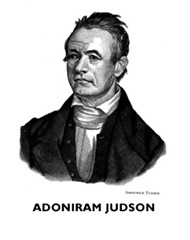
adoniram-judson Adoniram, like so many other Baptists, was born in a Congregationalist home. He had the “unusual gifts of concentration, extended labor, and mental alacrity [liveliness].”7 His brilliance became his idol. He attended Providence College (now Brown University). At the university, Judson linked with an intellectual skeptic, William Eames, who persuaded him to abandon his religion. Through the providence of God, Judson heard the agonizing, fearful moans of his friend as he passed away.

Softened by this experience, Judson accepted his father’s counsel and enrolled at Andover Theological Seminary. At Andover, Judson’s mind was challenged by the well explained truths of God’s word. He acknowledge Christ as Savior and Lord on December 1808.

While at Andover, Judson developed a friendship with some others who already devoted themselves to missions work. One of the men was Luther Rice. Upon graduation, these two men joined a Congregational society for foreign missions and were commissioned to Calcutta, India. Judson took his wife Ann. Rice’s fiancé, opposed to missions in a foreign land, abandoned him.

They left for the mission field in 1812 during the war. Rice and the Judsons boarded separate ships to increase the chance that at least one of them would arrive. While sailing to India, Rice engaged in a debate with another passenger regarding baptism. Hence, Rice rejected his belief in infant baptism. Likewise, Judson, reading through his Greek New Testament became convinced of believers baptism. When they arrived in India, they concurred on the subject of believer’s baptism. They knew this would set them at odds with their mission society and lead to a drop of their support. Ann Judson’s words sum up their concerns well:

Can you, my dear Nancy, still love me, still desire to hear from me, when I tell you I have become a Baptist? If I judge from my own feelings, I answer, you will, and that my differing from you in those things which do not affect our salvation will not diminish your affection for me, or make you unconcerned for my welfare. You may, perhaps, think this change very sudden, as I have said nothing of it before; but, my dear girl, this alteration hath not been the work of an hour, a day, or a month. The subject has been maturely, candidly, and, I hope, prayerfully examined for months.8
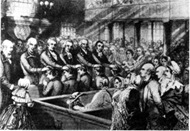
ordination-first-missionaries When the Judsons and Rice arrived in Calcutta, India, they were baptized. Rice agreed to go back to America to cut off their connection with the Congregationalists and solicit support from the Baptists. This he did. He was one of the great leaders who formed the Triennial Convention. From that time forward, Rice served in America, raising support and preaching across the states about missions. Lest we think he chose to remain in America for its comforts, consider the following:

Rice swam rivers, braved snowstorms, endured the heat, and at times detoured to avoid hostile Indians or bandits, lodging in homes along the way when he could find them, under the open sky when he could not.9
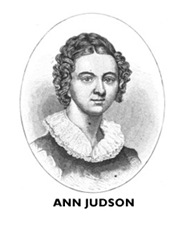
ann-judson The Judsons disassociated themselves from the Congregational mission work and served under the Triennial Convention. The Judsons were expelled from their mission work and began in Burma.

Their mission work in Burma was difficult. Judson was imprisoned. Just after his release from prison, Ann passed away. He remarried twelve years later. His second wife died after eleven years of marriage. He married again, only to see his third wife die within a few years.

Judson’s tenacity and perseverance demand our attention. He returned to America in 1846 for only one year, after having spent 33 years on the mission field. He was sought out to speak in many churches. However, because of a throat ailment, he could not speak. He composed his messages while others spoke them.

Judson not only increased missions in the minds of Americans, he provided the Burmese with a grammar book and left them with the entire Bible in their own language.

Baptist Expansion

Baptists continued to grow in spite of the theological difficulties and social ills (i.e., slavery). Church historian, Robert Torbet identifies four factors for Baptist growth in the 1800s:

  • interest in foreign missions,
  • home mission concern,
  • education,
  • and prayer.”10

How does this factor in numbers? In 1832, 14 missionaries were in Burma. By 1838, the number of missionaries increased to 98. That means in six years time, 84 missionaries were sent to the field. Growth continued for by 1841, 129 missionaries were on the fields.11

It should come as no surprise that the Baptists increased in their numbers. The following table illustrates the continued growth.12
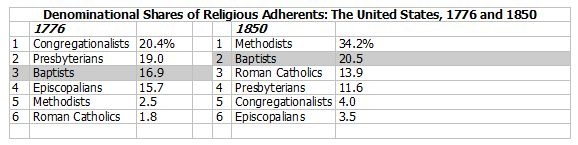
denominational-shares-religious-adherents-united-states

Conclusion

The Great Awakening and the mission work of the English Baptists encouraged the growth and mission-oriented mind of American Baptists. We find the following important lessons in this period of history:

1. Mission work abroad encourages mission activity at home.

2. Mission work abroad is based on solid ministries at home.

3. Mission work at home is often as difficult as mission work abroad. Acts 20.22–24

4. Pray for souls to be converted. 1 Timothy 2.1–4
family-religious-learning-home


1 Edwin Gaustad, A Documentary History of Religion in America to the Civil War, 280.

2 McBeth, History, 344.

3 From Proceedings

4 Annual Report, American Baptist Home Missionary Society, 1835, 13–14. Cited in McBeth, Sourcebook, 225.

5 Daniel Stevens, The First Hundred Years of the American Baptist Publication Society, 114. Cited by McBeth, History, 361.

6 Gaustad, History of Religion, 386

7 Nettles, By His Grace and for His Glory, 148.

8 Letter to a friend, September 7, 1812.

9 McBeth, History, 351.

10 Torbet, 332.

11 Torbet, 337.

12 Noll, History, 153.
Baptist Growth, Separation, and Struggle During the 1700s

Lesson 9: Baptist Growth, Separation, and Struggle During the 1700s

Baptists are throughout America, uniformly and almost unanimously, the firm friends to civil liberty, and the persevering promoters of our glorious Revolution.
George Washington

The state church in America was facing inner turmoil regarding its theology and polity. As early as 1622, a Half-way covenant was established. This covenant would allow baptized infants half entrance into church membership. Children of godly, professing believers could now be considered members of the churches even though those children did not possess salvation themselves. The slippery slope of compromise soon settled in. By the 1700s, this practice developed a mind set whereby some began to believe that infant baptism itself converted the infant.

This practice and downgrading of theology did not set well among many. It sparked a revival among the Congregationalists, Puritans, and Presbyterians. Men wrote and traveled throughout the colonies preaching the doctrine of salvation, recapturing the truth of salvation by faith alone. These preaching revivals, called the Great Awakening, swept across young America resulting in numbers of conversions. It was this Awakening which also led to radical growth among Baptists.

This growth brought with it certain struggles. People reacted differently to the revivals. Differences among Baptists became more apparent. Issues related to religious liberty also germinated.

The Growth of the Baptists

Men who were influential for the growth of Baptists

Theodorus Jacobus Frelinghuysen (1691–c. 1747)

A Dutch Reformed minister who arrived in New York in 1720. He tackled the Reformed hierarchy by demanding that only believers be allowed to take the Lord’s Supper. He was bitterly attacked by the affluent in his congregation. His “evangelical fervor and his itinerancy contributed to the onset of the Great Awakening.”1

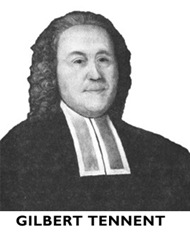
William and Gilbert Tennent

gilbert-tennent This father and son worked among the Presbyterians bringing revival back to their denomination, namely the New Side Presbyterians. They established the Log College which trained the “New Sides.” Gilbert was so well known that George Whitefield sought him out.
Jonathan Edwards

Edwards is considered to be among the ranks of the greatest theologians. He was well educated at Yale University. His grandfather was a well-known congregational preacher (Solomon Stoddard.)

Edward’s influenced the Great Awakening by his preaching tours and his writings. His example well illustrates that theology is evangelistic. Though most well-known for his sermon, “Sinners in the Hands of an Angry God” he wrote over 1,200 sermons and many theological treatises. His two major treatises were: Freedom of the Will and Original Sin.

Edwards was called as president to The College of New Jersey (Princeton). He died only weeks after moving into that position.

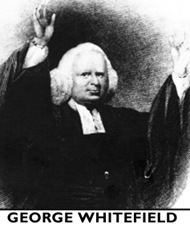
George Whitefield

george-whitefield Whitefield, a Methodist preacher from England, made five preaching tours throughout America.2 He gained an appreciation of the evangelistic fervor from the Wesley brothers, though he “parted company” from them due to their Arminian theology.

His tours drew millions of people. He had an exhausting itinerary, usually not staying more than a day in a particular city and preaching over 7,500 sermons combined.

Whitefield retained much of the pietism he learned from the Wesley’s. He preached ex tempore believing that using a manuscript inhibited “inspiration” of the Holy Spirit.3 One further describes Whitefield’s preaching style in the following way:

“Besides pathos and tears, Whitefield frequently appealed to his listeners’ imaginations as he enacted the agonies of damnation and the ecstasy of salvation . . . . Tears, passions, and consolation fused in Whitefield’s sermons to produce a new and powerful form of preaching. Although endowed with a voice that was often likened to the “roar of a lion,” Whitefield offered a message not primarily of fear and hell-fire but of compassion, suffering, and comfort.”4

Whitefield’s style was imitated and exaggerated by many revivalists in the 1700s and beyond.

Shubal Stearns

Stearns was converted under the ministry of George Whitefield’s second tour in the States (1745). Convinced by Scripture that the Congregationalists were not thoroughly biblical, he became a Baptist. In 1755 he led a group of fifteen men to the South and began the Sandy Creek Church. This church planted other churches which eventually formed the Sandy Creek Association. This church is considered the grandmother of the Southern Baptists.

Stearns apparently imitated the pietistic preaching of Whitfield. His preaching was described as “musical and strong . . . mak[ing] soft impressions on the heart . . . throw[ing] the animal system into tumults.”

Hezekiah Smith

Smith was educated at Princeton and associated with the Philadelphia Baptist Association. Traveled through the South as an itinerant evangelist. “During this fifteen months he traveled on horseback four thousand two hundred and thirty-five miles, and preached on hundred and seventy-three sermons.”5 He helped found a college in Rhode Island. Became a pastor in Havervill, Massachusetts (1766) and ministered there for 39 years. He founded the Massachusetts Baptist Missionary Society in 1802.

Associations which were influential for the growth of Baptists

Philadelphia Baptist Association (est. 1707)

philadelphia-baptist-association This Association, established by Elias Keach et al sent ministers and evangelists to destitute churches. Two outstanding men were Morgan Edwards and John Gano. Gano established churches in New York and New Jersey. The number of churches planted were substantial. Within 60 years, nearly 1,200 churches were started.
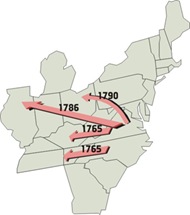
The PBA “mothered” many other associations: Charles Association (1751); Sandy Creek Association (1758); Ketockton Association (1765); Kehukee Association (1769); Strawberry Association (1776).6

brown-college The PBA also influenced the growth of Baptists by founding Rhode Island College (now Brown University). From this college came many Baptist pastors. This also did much to alleviate the negative attitude toward education among the Separate Baptists.
Warren Association (est. 1767)

Chief leaders of this association were Dr. Manning (president of Rhode Island College), John Gano, and Isaac Backus. It was mainly established for the purpose of securing religious liberty.

By 1800 there were forty-eight associations in the country; thirty in the southern states, and eight beyond the Alleghenies.

Other factors that led to the growth of the Baptists

Besides the obvious influence of the Great Awakening, other factors induced a swelling of Baptists in the 1700s. McBeth identifies the Great Awakening and two others: immigration of the English and Welsh Baptists and the improved social status of the dissenters.7

The statistical data regarding the growth of the Baptists

The increase in the number of Baptist churches in the colonies between 1740 and 1776 was significant, for by the latter year there were 472 churches as over against approximately sixty at the time of the Great Awakening, a tenfold gain. By 1795 Backus estimated that there were a total of 1,152 churches scattered through sixteen states and territories.8

One historian compared the number of Baptists with the number of the general population. In 1776 1 Baptist could be found among 264 people. By 1800 the ratio was 1:53, by 1850, 1:29.9

expansion-west

Separations among the Baptists

There was enough variety of Baptists in the 1700s that a denominational consolidation was not present. However, the different reactions to the revivalism in America did bring to light more noticeable differences among the Baptists that they became quite distinguishable.

The conflict between genuine and false revival

The spirit of revival swept across America, but along with it, aberrations of true revival also developed. It is true that salvation brings with it certain emotions. However, some regarded emotional experience as a “sign” of true spiritual revival. Among the genuine revivals, false revivals were marked by: “weeping, wailing, the “holy laugh” . . . dancing . . . barking like a dog, uncontrollable jerking or muscular spasms of the body, and falling to the ground in a dead faint.”10 God’s character was at stake. True revival among some Baptists was no longer viewed as a “surprising work” of God but could be induced by human means.

This conflict brought to light noticeable differences among the Baptists:

Separate Baptists

The Separate Baptist movement was energized by the preaching of Whitefield and the “New Light” Congregationalists. Many Separate itinerant evangelists mimicked the preaching style of Whitefield.

camp-meeting Mark Noll states “If anything, this depiction of a frontier camp meeting suggests less drama than was typically associated with such events.”
lso, the “New Light” Congregationalists, so named because they were “enlightened by the revivals, were fast becoming Baptists. It has been said that the “New Light Congregational status [was] a halfway house on the road to becoming Baptists.” The New Light movement was further described as a “nursery of baptists.”11

The Separates were the more pietistic among the Baptists. They believed the following:

“Confessions lead to creedalism, therefore, confessions are to be rejected.” The Separates would not use the Philadelphia Confession. The “Bible alone” was their platform.12

“Exhortation rather than exposition is the biblical mode for preaching.”13 As a result, the Separates did not prepare their sermons. They disparaged manuscript sermons.14

“Educational preparation of their pastors was not important.” Whether they were able to secure an education for themselves is not known. Yet, they had an anti-education mindset.

“To preach for money was just a notch above Judas who denied [Jesus] for money.”15 Therefore, they did not pay their ministers a salary.

The Separates also differed from other Baptists in that they allowed women preachers and devised a sensational invitation system. The invitation system is described by on writer:

“At the close of the sermon, the minister would come down from the pulpit and while singing a suitable hymn would go around among the brethren shaking hands. The hymn being sung, he would then extend an invitation to such persons as felt themselves poor guilty sinners, and were anxiously inquiring the way to salvation, to come forward and kneel near the stand.”16

Regular Baptists

The Regular Baptists participated in and also enjoyed the fruits of the Great Awakening. They were quick to shy away from the pietistic emotionalism. The Regulars were the opposite of the Separates on all of the above points.

A common (but false) paradigm used to distinguish between the Regulars and the Separates is that the Regulars were characterized by Order, the Separates by Ardor [fervency].17 Though this is interpreted by some to be the advantage of the Separates, the Regulars were as well marked by fervency.

The Struggle for Religious Freedom

The colonies all struggled with the concept of religious freedom. The colony of Rhode Island had virtual liberty while the state of Virginia seems to have been the most intolerant. The reasons for Virginia’s intolerant attitude toward religious liberty are varied, but chiefly the state church in that region was stronger than the other colonies.

The Baptists (Separate mainly) were growing rapidly. Many Separates were accused of “disturbing the peace” and were either fined or imprisoned. Whippings were meted by the local sheriffs in some cases without due course of law.

The destruction of the Revolutionary War delayed religious freedom.

Churches on the trail of the war were damaged, looted, and often destroyed. For example, John Gano’s church was used as a stable by the British army. When he returned at the end of the war, he found only 37 out of the 200 members remaining.18 With the shrinking influence of the Baptists, religious freedom was further away.

That was not to be the situation for long. The Baptists quickly sprang back. Gano’s church was enlarged to its pre-war size within two years of his return.

Certain factors that led to Religious Liberty
The Revolutionary war did provide some positive results

During the Revolutionary War, Baptists, for the most part, gained an increase status in the eyes of American society. The Philadelphia Baptist Association was behind the American efforts in the war.19 Hence, many Baptist pastors (e.g., Hezekiah Smith and John Gano) served as chaplains. Their patriotism was evident in the eyes of the American people.

Men who brought about Religious liberty

Interestingly, it seemed as if everyone wanted Religious Liberty. The Baptists wanted liberty from a state church. Thomas Jefferson wanted liberty from the Baptists. God raised up two influential people to gain religious freedom.

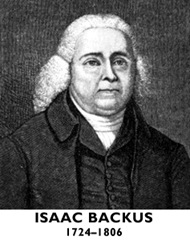
Isaac Backus

isaac-backus Considered the “greatest Baptist spokesman for religious liberty in America,” Backus chaired the Grievance Committee of the Warren Association. Essentially that committee formed a strategy for securing religious freedom.
Backus was a brilliant man who read much. He could quote Jonathan Edwards and John Locke’s works with ease.20 He traveled as an itinerant evangelist nearly 15,000 miles. In eleven years, he preached 2,412 sermons (about one every 1.66 days).

Through different treatises on the subject of religious freedom, and political maneuvers, he brilliantly fought for religious freedom in the following ways:

  • Backus brought the liberty problem to the attention of the London authorities by publishing it in the Boston Evening Post, July 20, 1770. The American leaders did not want to complicate issues with securing independence from England, so this maneuver forced the American leaders to pay attention and appease the Baptists.

  • Backus also appealed to the Baptists to stop paying taxes to the state church on the basis that they were being taxed without representation. This was a parallel problem faced in America. England was forcing taxes upon the Americans. They did not want to pay England taxes, so why should Baptists pay State Church taxes?

  • The reality that Baptists were so numerous had its advantages. America needed Baptist help in fighting the Revolutionary War, so the Baptists had to be appeased.

Though full religious liberty had not been achieved, these appeals and facts rested on the minds of the framers of the constitution. “With the attainment of civil liberty came a spirit that made men see in religious persecution the tyranny and shame that it was.”21 Though Backus did much to promote religious liberty, John Leland helped secure it.

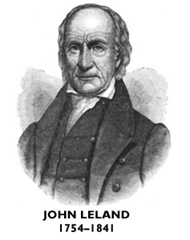
John Leland

john-leland Positioned in the most intolerant colony of Virginia, John Leland helped win religious liberty for the Baptists. Leland was a powerful spokesman for religious liberty as well.
During a conference of Baptists on March 7,1788, Leland eloquently revived the principles which Roger Williams and John Clarke raised a century earlier. His speech was so well received that knowledge of it spread throughout Virginia.

Leland was a popular preacher who developed a keen mind on politics. Thomas Jefferson himself attended Leland’s church on occasion.

“In numerous letters, Leland pleaded with [James] Madison to incorporate guarantees into the Consititution.”22 Since the Constitution did not spell out and guarantee religious liberty, the Baptists made it clear to the framers that the Constitution would not be ratified. Leland wrote ten Objections to the Constitution and presented it to James Madison. To complicate issues, Leland ran for office opposite Madison.

Not wanting to lose the Constitution to a Baptist protest, nor an election, Madison met with Leland in March of 1788. At that “secret meeting” Madison agreed to spell out the freedoms the Baptists desired as long as Leland withdrew from the race.23

This won the day for religious freedom in America, for James Madison kept his promise and brought the subject of an amendment to the constitution to the House of Representatives.

The Amendment finally adopted reads as follows:

“Congress shall make no law respecting an establishment of religion, or prohibiting the free exercise thereof; or abridging the freedom of speech, or of the press; or the right of the people peaceably to assemble, and to petition the Government for a redress of grievances.”

One historian wrote:

“Freedom of conscience, unlimited freedom of mind, was from the first the trophy of the Baptists.”24

Conclusion

The Baptists rode the wave of the Great Awakening securing for themselves a greater number, denominational structure, and religious freedom. While we enjoy the freedom and theological foundation laid by our Baptist forefathers, let us not rest in evangelizing others, discipling them as Baptists, and securing for our future the blessings we now enjoy.

Lessons we can learn

1. God works in a “surprising” way to revive His people. Revival comes, not because man works up revival through emotionalism, rather God sends it as He pleases. Often, God is pleased to send revival as people are instructed through His Word and they obey it. Though this is not a guarantee of national revival, it is a guarantee of personal revival.

So on the first day of the seventh month Ezra the priest brought the Law before the assembly, which was made up of men and women and all who were able to understand. 3 He read it aloud from daybreak till noon as he faced the square before the Water Gate in the presence of the men, women and others who could understand. And all the people listened attentively to the Book of the Law. . . . Ezra opened the book. All the people could see him because he was standing above them; and as he opened it, the people all stood up. 6 Ezra praised the LORD, the great God; and all the people lifted their hands and responded, “Amen! Amen!” Then they bowed down and worshiped the LORD with their faces to the ground. . . . 8 They read from the Book of the Law of God, making it clear and giving the meaning so that the people could understand what was being read. . . . Then all the people went away to eat and drink, to send portions of food and to celebrate with great joy, because they now understood the words that had been made known to them. . . . From the days of Joshua son of Nun until that day, the Israelites had not celebrated it like this. And their joy was very great. (Nehemiah 8.1–3, 5–6, 8, 12, 17)

2. Religious freedom is not necessary for our growth, expansion, and spiritual well-being. It is a grace given by God which should not be taken for granted (abused). During times of persecution the Baptists grew and expanded their ministries. During times of ease, the Baptists have also grown (next lesson). Let’s not comfort ourselves and forsake the mission of evangelizing and teaching others.

We want each of you to show this same diligence to the very end, in order to make your hope sure. We do not want you to become lazy, but to imitate those who through faith and patience inherit what has been promised. (Hebrews 6.11–12)

1 Dictionary of Christianity in America, “Frelinghuysen,” 454.

2 Actually he made seven trips to America, only five of them were preaching tours.

3 Dictionary of Christianity in America, “Whitefield,” 1252.

4 Harry Stout, The Divine Dramatist (Grand Rapids: Eerdmans Publishing Co., 1991), 42f.

5 Vedder, History, 310.

6 Vedder, History, 318; Torbet, History, 232.

7 McBeth, History, 200.

8 Torbet, History, 243.

9 Vedder, History, 319. f. 2.

10 Torbet, History, 222.

11 William McLouglin, New England Dissent 1630–1833, 1:424 and David Benedict, A General History of the Baptist Denomination in America, 549. Cited by McBeth, History, 205.

12 Torbet, History, 223.

13 Torbet, History, 223

14 This was an overreaction. While the Church of England ministers were notorious from reading their manuscripts with little enthusiasm, the Separates fled to the opposite “pole” and disdained any preparation for a sermon.

15 McBeth, History, 231.

16 George Paschal, A History of North Carolina Baptists, 1:308. Cited by McBeth, History, 231.

17 Walter Shurden, “The Southern Baptist Synthesis” Baptist History. Cited by McBeth, 234.

18 Torbet, History, 238.

19 Certain pacifist groups (Quakers, Mennonites) despised America’s revolution.

20 McBeth, History, 259.

21 Vedder, History, 319.

22 Gerald Priest, “John Leland and the Bill of Rights,” in The Baptist Bulletin, February 1988, 14.

23 McBeth, History, 282.

24 George Bancroft cited by Priest in “John Leland,” 14.

Baptist Beginnings in America

Baptist Beginnings in America

Definitely not the home of the free,
but surely the home of the brave

Until now, it was important for us to see the beginnings of Baptists in England. Beginning with this lesson, we will consider the Baptist beginnings in America. The establishment of Baptist thought in America is more complex than that of England. One historian (perhaps too sweeping in his analysis) notes that the Baptists in America were paving their own way.

The Baptist movement in New England was essentially an indigenous, parallel movement to that in England and not an offshoot or extension of it.1

While it is true that Baptists in America were a parallel movement to that in England, they do find the origins of their thought, and in some cases, their churches in England.

Coming to America

Even though America was a “howling wilderness” many considered it a land of promise. The Puritans found that reforming the Church of England may be easiest in a new locale. The Separatists fled to the new land to find freedom.

Establishing a new state church

The Pilgrims boarded the Mayflower to come to America because of Arch Bishop Lauds tyranny. On board the Mayflower were Puritans (with a sprinkling of Separatists). They landed on the shores of America on December 21, 1620. They established a colony along with their state church in Plymouth, Massachusetts.

Looking for freedom

The Baptists (and other dissenters) came over from England for the same reasons. They could no longer endure the tyranny of the Church of England. They thought “the Puritans who had shared persecution with them in England would receive them gladly.”2 They thought wrong. The Puritans were not committed to religious freedom as much as they were committed to establishing a pure state church. Hence, the Baptists were generally unwelcome.

Church historian, John Christian states that the “whole of New England was agitated on the subject of immersion.”3 It was not long after their arrival that the General Court (1644) enacted laws to penalize those who would not subscribe to the state church:

“it is ordered and agreed, that if any person or persons, within this jurisdiction, shall either openly condemn or oppose the baptizing of infants, or go about secretly to seduce others from the approbation or use thereof, or shall purposely depart the congregation at the ministration of the ordinance, or shall deny the ordinance of magistracy . . . and shall appear to the court wilfully and obstinately to continue therein after due time and means of conviction, every such person or persons shall be sentenced to banishment.”4

Banishment was a severe penalty for it meant one had to wander the “howling wilderness” with its dangers (Indians, wild animals, severe winters).

Arrival in America

Lest we think that the early Baptists were rabble rousers, we should take into consideration the words of Cotton Mather:

”many of the first settlers of Massachusetts were Baptists, and they were as holy and watchful and faithful and heavenly people as any, perhaps in the world.”5

The areas in which they settled

New England

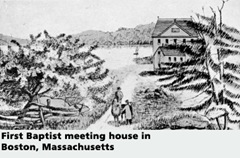
first-baptist-meeting-house The early Baptist settlers were from various regions in England.
From England came John Clarke who settled in Newport, Rhode Island (1644). Thomas Gould who settled in Boston, Massachusetts (1665). William Screven settled in Kittery, Maine (1673) and later moved to Charleston, South Carolina (ca. 1696)

From Wales came John Myles who settled in Rehoboth (1663) and later moved to Swansea.

Because of the Puritans, growth in New England was slow. “In 1700 there were only ten small churches with not more than three hundred members.”6

The Middle Colonies

The First Baptist Meeting House in Boston, Massachusets

The middle colonies were more favorable to growth than New England. There was a “commingling of religious and cultural groups which made for a greater toleration than would have been possible otherwise.”7 The General Baptists (Arminian) settled in New England, while for the most part Particular Baptists (Calvinists) settled in the Middle Colonies. In the south both groups were represented.

Pennsylvania and New Jersey gave more religious liberty than any other colony. The Baptists from Wales, Ireland, and England settled in the area. The city of Philadelphia became a place of convergence for these groups.

From England, Elias Keach with others settled in Dublin Township near Philadelphia (1688) and made rounds to other cities (Middletown, 1688; Piscataway 1689; Cohansey, 1690; Philadelphia 1698)

The South

Initially, the greatest concentration of Baptists was in the North. Very few congregations were founded in the South until the Great Awakening in 1726.8 Usually those churches planted in the south were established by those who were forced out of New England (e.g. Screven was driven from Maine to South Carolina).

Since Virginia was first settled by the English (ca. 1619), they were unfavorable to the dissenters.

A contingent of General Baptists from England settled in circa 1700. Later, they summoned the Particular Baptists in London to send them preachers. Robert Nordon came in 1714.

A group from Maryland moved into Virginia between 1743–1756. It was this group, “owing in all probability to their contacts with the Philadelphia Association” that brought Calvinism to the South.9

Problem in America

The Baptists left England because of religious persecution in England. They believed they would receive a warm welcome by the Puritans and Congregationalists for they also were persecuted in England. Not so. Once they arrived they met severe opposition. The Puritans were very strict and demanded that others conform to their ways. This was not the freedom that the Baptists expected to find.

One example of the attitude toward the Baptists can be found in the situation at Harvard.

Henry Dunster came to America in 1640. He was made the first president of Harvard. A well respected president, Dunster made Harvard a schola illustra10 which “flourished in the profession of all liberal sciences for many years.”11 Dunster, himself, was regarded as a master of the oriental languages.

He was present at many trials against Baptists. Having witnessed the trial of John Clarke (et al) he became convinced of believer’s baptism. He began to preach the same in his own church at Cambridge. This quickly forced his resignation as President in 1653.

The Overseers of the College were heartless individuals. They threw Dunster and his family out of the president’s home (which he built) in the middle of winter. Later, he was brought to trial for failing to sprinkle his infant daughter. He died five years after he resigned his position at Harvard.

Conflicts among the Baptists

To add to the dilemma, Baptists found themselves in some internal conflicts.

  • Arminianism vs. Calvinism
  • Laying on of hands in baptism for membership
  • Singing in church
  • 7th day Baptists worshiping on Saturdays12

Leaders in America

Four influential men arrived in America. Keach was a Baptist before he came, while three others (Knollys, Clarke, and Williams) developed into Baptists after their arrival.

Knollys arrived in 1638

Hanserd Knollys fled to America and started a church in Piscataway (now Dover) New Hampshire. At this time, Knollys still could not be considered a Baptist. However, his church in New Hampshire was split on the issue of infant baptism. This brought persecution on him by the Congregationalists. He, with others from his church, fled to New Jersey and eventually back to England.

Roger Williams arrived in 1631

roger-williams-shelter Roger Williams was born in London, England circa 1603. He was an intelligent young man that served as a clerk under a famous jurist Sir Edward Coke. He went to Pembroke College, then to Cambridge University. It was during his senior year at Cambridge that he began questioning many of the Anglican beliefs.

He became a Puritan, then a Separatist, and fled to America ten years after the landing of the Mayflower. He had a good reputation for the governor of Massachusetts. John Winthrop said of him:

Williams is “a charming, sweet-tempered, win-ning man, courageous, selfless, God-intoxicated, and stubborn, the very soul of separation.”13

Offered the position of pastor in Boston, Massachusetts. He refused citing their failure to separate from the Church of England.

When he got to Boston, he was given the offer to be the pastor of a very influential church. He considered it an “unseparated church” and “durst not officiate it.” He went to Plymouth to be the assistant Pastor to Ralph Smith. This pastor said of Williams, “A man godly and zealous having many precious parts, but very unsettled in judgment.” Williams left this church because it was not separated enough.

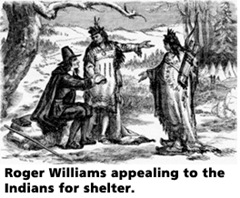
He went to Salem and became the teacher of a church. He voiced opposition to the Puritans. He accused the King of England for being unchristian, was brought to court three times, and finally was banished into “those wild tracts of nature where the wolf, the bear, and the panther roamed in all their voracity.”14 It was during that time that the Indians welcomed him and took him into their wigwams.15

He fled to Providence to help John Clarke establish Rhode Island. Williams went to England himself to get the charter signed. When he came back to America, he wrote many pamphlets on religious liberty.

statue-roger-williams It was only three or four months that he was in Providence that he soon denied that baptism was biblical. He imbibed in mysticism. He became a seeker.

Despite the fact that he drifted down many theological streams, Williams did much to secure religious freedom. He became known as the “Father of Religious Liberty in America.” This designation should not be applied only to Williams for Clarke had much to do with securing liberty as well.

Though Roger Williams did set the groundwork for religious liberty, his church did not expand itself. By 1750, fifty five Baptist churches existed, not one of them deriving from William’s church. Hence, Williams cannot be rightly considered the originator of Baptists in America.16

John Clarke arrived in 1637

Born in England he was both a physician and a theologian. A Puritan, Clarke had remarkable skills in handling the Hebrew and Greek languages.

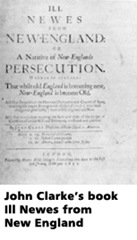
john-clark-book He crossed the “pond” and stepped on American soil 17 years after the Mayflower landed. When he arrived in America he found that the Puritans were in a dispute so he took a group of people New Hampshire. The winters were so severe that the group fled “south” to an island called Aquidneck. He purchased it from the Indians and called it Rhode Island. He and a group of men established two colonies – Portsmouth and Newport.

Clarke and Williams ministered together in this church. Clarke became the “teaching elder” of the first church in Newport. It became Baptist by 1648.17

God used Clarke to secure religious freedom for the Baptists in Rhode Island. This was just short of a miracle for a few reasons.

  • Charles II did not like those who didn’t conform to the Church of England (Anglican Church)
  • Better yet, to offer freedom to a man who was now across the sea would be dangerous to Charles II.
  • The statement that Clarke wanted to adopt would be very liberal in the eyes of Charles II.

“Your petitioners have it much on their hearts to hold forth a lively experiment that a flourishing civil State may stand . . . with a full liberty in religious concernments.”

Elias Keach arrived in 1688

Elias rode on the coat tails of his famed father, Benjamin Keach. With that fame, Elias became a pastor in England without giving a testimony, nor having been baptized. He became a popular speaker and secure invitations to do so throughout London. The family name was good enough.

When he got off the ship in America, he strode into a church in Pennepeck, Pennsylvania sporting the garb of a clergyman. During his first sermon, we became so convicted that he confessed his imposture.18

He preached with unusual fervor from that day forward. He traveled to many cities and saw many come to Christ. He desired to make all of the new converts a part of his church in Pennepeck. Because of the distance between the cities, they gathered twice a year for a combined church service. This eventually failed and these believers began their own churches.

These churches combined to make the first Baptist association in America, The Philadelphia Baptist Association. It took nearly forty years for this Association to adopt a doctrinal statement for they did not want to offend the General Baptist churches. In 1757 it had a membership of twenty-five churches. By 1762, there were twenty nine churches with 4,018 members.

Associations must not replace or undermine the authority of individual Baptist churches. This principle was recognized early in Baptist history. A man by the name of Benjamin Griffith wrote:

“That an Association is not a superior judiacature, having such superior power over the churches concerned; but that each particular church that a complete power and authority from Jesus Christ, to administer all gospel ordinances . . .”19

McBeth identifies several purposes for which The Philadelphia Baptist Association existed:

  • It served as a “doctrinal monitor.”
  • It was an “advisory council in matters of local concern” and to help “settle disputes” in the churches.20
  • It helped churches find pastors and pastors find churches. It also “was particularly careful to examine the credentials of itinerant preachers and to warn the churches of such impostors.”21
  • It helped with benevolent work. This included an educational fund, sponsoring a Baptist college, fighting for religious liberty.
  • It provided fellowship for Baptists.
  • It provided models for preaching. “Preaching was always a major feature of association meetings, and churches put forward their best preachers.”

Conclusion

Lessons we can learn from the early American Baptists:

sea-monsters 1) It has been well said that “the colonial period . . . is marked by faithful witness to the truth on the one hand, and by bitter persecution on the other.”22 In spite of persecution and fear of being banished into the “howling wilderness” believers persevered. That perseverance issued into the expansion of Baptists in America.

But whatever was to my profit I now consider loss for the sake of Christ. What is more, I consider everything a loss compared to the surpassing greatness of knowing Christ Jesus my Lord, for whose sake I have lost all things. I consider them rubbish, that I may gain Christ and be found in him, not having a righteousness of my own that comes from the law, but that which is through faith in Christ – the righteousness that comes from God and is by faith. I want to know Christ and the power of his resurrection and the fellowship of sharing in his sufferings, becoming like him in his death, and so, somehow, to attain to the resurrection from the dead. (Php 3.7–11)

2) Men of all calibers showed courageous, sacrificial determination to carry out the Great Commission.

For the grace of God that brings salvation has appeared to all men. It teaches us to say “No” to ungodliness and worldly passions, and to live self-controlled, upright and godly lives in this present age, while we wait for the blessed hope – the glorious appearing of our great God and Savior, Jesus Christ, who gave himself for us to redeem us from all wickedness and to purify for himself a people that are his very own, eager to do what is good. (Tit 2.11–14)

3) Doctrinal consistency was important to the early believers. Planting churches and associating with one another centered on similarity in doctrine.

I felt I had to write and urge you to contend for the faith that was once for all entrusted to the saints. For certain men whose condemnation was written about long ago have secretly slipped in among you. They are godless men, who change the grace of our God into a license for immorality and deny Jesus Christ our only Sovereign and Lord. (Jude 3–4)

1 New England Dissent 1630–1833: The Baptists and the Separation of Church and State, 1:6 quoted by Gerald Priest.

2 Torbet, History, p. 201.

3 Christian, History, p. 362.

4 Isaac Backus, History of the Baptists in New England. 1:359–60, Cited in John Christian, History, p. 369.

5 Cotton Mather, Magnalia, 2:459. Cited by John Christian, History, p. 359.

6 Vedder, History, 302.

7 Torbet, History, p. 209

8 Ibid. p. 214

9 Ibid. p. 216

10 Literally, “a glorious school.”

11 Prince, Preface to New England Psalm Book. Cited by John Christian, History, p. 365.

12 This group still exists today.

13 quoted by Gerald Priest

14 Armitage, History, p. 642.

15 This was not an unusual kindness for Williams earlier “visited their wigwams, learned their language, and preached to them the good news of the kingdom . . . his sufferings touched the savage heart.” Ibid.

16 John Christian, History, p. 376f.

17 Maybe even four years earlier, but extant records show the date of 1684. See Torbet, History, p. 203.

18 Torbet, History, p. 210.

19 Quoted by McBeth, History, pp. 243–4.

20 Torbet, History, p. 245.

21 Ibid.

22 Vedder, History, p. 287.

Focusing on the Mission

Focusing on the Mission

The mission of the local church is to reproduce itself. This involves reproducing other churches near and far (Ac 1.8). These plants should be doctrinal (2Ti 1.13–14) and philosophical (1Ti 3.14–15) reflection of the mother church. The heresy of Hyper-calvinism destroyed the focus of this vision in the 1700s. Hence the Baptists lost many churches during this period of decline.

It was also during this time that God was pleased to raise up some men who were devoted to the mission of the church. Two such men were Andrew Fuller and William Carey. These men did not invent a new doctrine to revive the church. Rather, they relied on Scripture and reasoned in a biblical manner.

They saw the revivals sweeping across America, led by George Whitfield and Charles Wesley. No doubt these revivals energized their desire to promote the mission of the church. Yet, “in many respects the writings of Jonathan Edwards were the single most important theological influence on Fuller, Carey, and the English Baptists.”1

Andrew Fuller

His Background

andrew-fuller Fuller was born in into a Cambridgeshire farming family in 1754. He was a big man who took up wrestling as a sport. “Years later, so tradition says, when he met another strong man he would give him an appraising glance and mentally calculate if he could still defeat such a man.”2

At the age of sixteen, he witnessed a baptismal service (March 1770). Through this example and the teachings of Scripture, he was baptized a month later. By the next year he was preaching in a church in Soham. Though he “durst not” preach the gospel to sinners.

All that changed in 1775 when he came across a pamphlet which opposed Hyper-Calvinism. This pamphlet and the Scriptural examples of Christ showed him that he needed to “address the gospel to sinners and invite them to believe.”3 Fuller called Hyper-Calvinism “False Calvinism.” and rightly so.

How would his church receive this change of theology? Not well. It eventually led to his dismissal. Unfortunate as that may be, it was the antagonism in that church that forced him to be clear and convincing. One historian states he was a “sound and edifying preacher, but not a great orator; nevertheless, few pulpit orators have had so wide a hearing, or so deeply influenced their generation.”4

His influence was most widely known by his writings. He was “one of the most widely read and influential theological writers of England or America.”5

His Sacrifice

In those harsh days, it was common for children to die in infancy. Of his eleven children, only three survived. His wife also died after giving birth August 23, 1792.

In spite of his recent widowing, he along with thirteen other pastors formed the first Baptist missionary society. He was elected secretary and traveled all of England, five times to Scotland and once to Ireland – he was not paid for his services.

His Thought

Andrew Fuller was a Modified Calvinist. That is, he believed in the five doctrines of Calvinism. He explained Limited Atonement as “Christ’s death was sufficient for all but efficient for only the elect.” He found himself strangely labeled an Arminian by the Hyper-Calvinists and Hyper-Calvinistic by the Arminians. Modified Calvinists became known as Fullerists.

The writings of Jonathan Edwards helped Fuller understand how divine sovereignty and human responsibility did not contradict. As he worked through his own theology, he refrained from publishing for a long time. The theology of the Hyper-Calvinists was popular and their logic persuasive. Eventually, he published his book The Gospel Worthy of All Acceptation. He expected controversy and received it from both the Arminian and Hyper-Calvinist camps.

His Book – “The Gospel Worthy of All Acceptation”

This book clearly sets forth his Calvinistic thought. Throughout the book, Fuller expressed that a belief in the doctrines of grace supports and encourages missionary activity. Historian Timothy George identifies five main teachings of this book. [Bold mine emphasis]

  • Unconverted sinners are commanded, exhorted, and invited to believe in Christ for salvation.

  • Everyone is bound to receive what God reveals.

  • The gospel, though a message of pure grace, requires the obedient response of faith.

  • The lack of faith is a heinous sin which is ascribed in the Scriptures to human depravity.

  • God has threatened and inflicted the most awful punishments on sinners for their not believing on the Lord Jesus Christ.

  • The Bible requires of all persons certain spiritual exercises which are represented as their duty. These include repentance and faith no less than the requirement to love God, fear God, and glorify God. That no one can accomplish these things apart from the bestowal of the Holy Spirit is clear. Nonetheless the obligation remains. In this respect man’s duty and God’s gift are the same thing, seen from different perspectives.

Another historian states: “As a scholarly man of deep devotion and marked literary gifts, he was well fitted to restate Calvin’s teaching in terms of the individual’s responsibility to witness to the gospel. Indeed, his missionary zeal and sound judgment constituted the chief cause for the awakening of Baptist missionary impulse among Particular Baptists. To him also belongs the credit for doing much to break down the anti-missionary spirit of hyper-Calvinists. It was he who gave William Carey, the youthful prophet of missions, encouragement and recognition of his talents.

William Carey

His birth and re-birth.

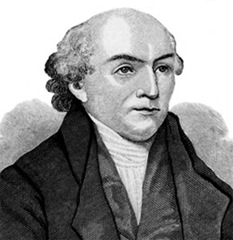
william-carey Carey was born August 17, 1761, the son of Edmund and Polly Carey. Carey’s uncle Peter was more of a father to him than his own father. Peter served with the British army, undoubtedly having participated in the British/Indian war. He told young Carey of adventures on the sea, in Africa, the New World, and India.
Carey was a diligent young man. He taught himself Latin at the age of 12. Not afraid of work, he cobbled shoes until he was 28. The young cobbler also taught himself to read his coworker’s Greek New Testament. Later Carey would learn Hebrew and teach himself Dutch and French. These languages were learned.

A fellow cobbler lent him books and witnessed to him in the shop. Even though Carey would often win the debates, he realized the truth of his situation. He was a sinner in desperate need. By this man’s witness, as well talks with other believers, Carey was saved.

At the age of 19, Carey married Dorothy Plackett, who at the ripe old age of 24 was about to be declared a “spinster.”6 The marriage began with many difficulties. Their firstborn, Ann, died when she was 2 years old. The same fever that killed their daughter almost took Carey’s life, leaving him bald for the remainder of his life. Carey’s sister was widowed at about the same time, leaving Carey responsible for her well-being and the well being of her four children. Given all of the difficulties, Carey continued to pursue a life-long study of God’s Word.

His formative years

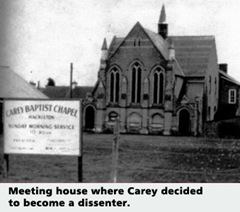
meeting-house-care-dissenter Having been persuaded by the preaching of Hebrews 13:13 by Thomas , Carey became a Dissenter. Quite a move for Carey, for before his own salvation, Carey had thought of destroying the building in which where the dissenters met.
In 1782, Carey, and other dissenters, were invited to the Northamptonshire Baptist Association in Olney. There he heard Andrew Fuller preach “Be Not Children in Understanding.”

Though a Dissenter, Carey was not yet a Baptist. He listened to the preaching of those who practiced infant baptism, yet was not convinced. He did take it upon himself to study the subject. He learned that baptism follows salvation and is properly administrated by immersion, not by pouring or sprinkling. He asked Pastor John Ryland to baptize him. Carey was baptized October 1783.

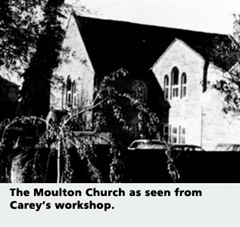
moulton-church Carey’s giftedness for preaching was recognized by a group of Baptist believers in Moulton. There he served the church making a mere 12 pounds a year which was enlarged with the addition of 5 more from the Particular Baptist Fund.

Carey’s married life in Moulton was enhanced by the arrival of three boys – Felix, William, and Peter. Despite the low salary and loss of their firstborn, Moulton was close to home for Dorothy.

His Preparation

Carey particularly enjoyed reading the newly published Journal of Captain Cook’s Last Voyage. In his words, “it was the first thing that engaged my mind in missions. His fascination with the world’s situation was so great he constructed a map in his workshop, compiling facts on populations, religions, and various other facts of each country. Those facts appear in his Enquiry. More is to be said about that below.

The Moulton ministry was demanding. To support his family, Carey had to teach school and cobble shoes. A deacon from Andrew Fuller’s church employed Carey to make boots for the British army. This boosted Carey’s income as well as work load. The deacon was a wealthy man who became interested in Carey’s remarkable abilities in the original languages (Greek and Hebrew). He encouraged Carey to end his shoe making and wholeheartedly devote his energies to the language studies. This deacon gifted Carey 10 shillings a week to make up for the loss. Another man by the name of Thomas Potts gave Carey money to publish his Enquiry so that it could be disseminated throughout the country.

Carey was pursued by the Baptist Church at Harvey Lane in Leicester. This was a city church which offered an increase in income. After a heart-rending decision, Carey accepted the call. The Carey family once again expanded with the blessed arrival of a girl they named Lucy.

The ministry in Leicester was a great challenge. The church was “meat grinder” for pastors. It had “just gone through three pastors in as many years. The church was so divided that Carey threw himself upon the grace of God. He led the congregation to dissolve itself and recharter its ministry. That meant everyone had to go through the membership process once again. Those who were not committed to spoiling the ministry did not bother reentering the membership process. They lost some members, but the church experienced a revival. It was not long before they had to build on to the church to accommodate the crowds. But all was not a “bed of roses” at Leicester, Carey suffered another personal tragedy. His daughter Lucy did not survive to see her second birthday.

In spite of the obstacles, Carey diligently plodded and worked. The following reflects his weekly schedule:

On Monday I confine myself to the study of the learned languages, and oblige myself to translate something. On Tuesday, to the study of science, history, composition, etc. On Wednesday I preach a lecture, and have been for more than twelve months on the book of Revelation. On Thursday I visit my friends. Friday and Saturday are spent in preparing for the Lord’s day; and the Lord’s day, in preaching the word of God. Once a fortnight (every two weeks) I preach three times at home; and once a fortnight I go to a neighbouring village in the evening. Once a month I go to another village on the Tuesday evening. My school begins at nine o’clock in the morning and continues till four o’clock in winter, and five in summer. I have acted for this twelve month as secretary to the committee of dissenters; and am now to be regularly appointed to that office, with a salary. Add to this, occasional journeys, ministers, meetings, etc.’ and you will rather wonder that I have any time, than that I have so little.

This situation at Leicester was such that Carey was not formally installed as pastor until nearly two full years had passed. On April, 1791, Carey was officially made pastor of the church. That evening Carey read portions of his unfinished Enquiry and Andrew Fuller preached “The Danger of Delay” a forceful message summoning his fellow pastors to evangelize the world. Though many pastors remained unmoved, the message apparently impacted some pastors to encourage Carey to finish and publish his Enquiry.

The Enquiry

One year later, the pamphlet was published and sent to London, Sheffield, and Leicester. How much exposure the pamphlet enjoyed at first is not known. Yet, this piece survived and so moved many that it has been dubbed “the first and greatest missionary treatise in the English Language.

In those days, titles for books and pamphlets were ponderous. The original name summarizes the content:

“An Enquiry into the obligations of Christians, to use means for the conversion of the heathens. In which the religious state of the different nations of the world, the success of former undertakings, and the practicability of further undertakings, are considered, by William Carey.”

The divisions of the pamphlet are as follows:

Introduction

One. The Great Commission Hyper-calvinists were teaching that the Great Commission was for only the disciples during the time of Christ. Carey exposes the fallacy of this understanding with the following arguments. First, he appealed to their inconsistency. The practice of baptism is found in the same commission. Second, he appealed to the ordinary practice of giving the gospel. If the great commission was only for the apostles, then everyone who gives the gospel errs. Third, he appeals to the clarity of Scripture. Matthew 28.20 specifically states that the gospel must go “to the end of the world.” Throughout the remainder of this unit, Carey soundly defeats various other Hyperist excuses for taking personal responsibility in delivering the gospel to the heathen.

Two. Earlier Missions Carey recounts the opposition the early apostles received for evangelizing the heathen. He gives the example of the Saducees tried to confound Peter and John’s evangelistic efforts. He details the difficulties Barnabus, Mark, and Paul endured on their missionary efforts. Then he turns to evangelist efforts of the early church fathers, enumerating the many countries through which the gospel spread. Through chronological progression, Carey tells of many who spread the gospel through civilized as well as uncivilized countries and how “God has considerably blessed their labours.”

Three. A World Survey Carey produced page after page of factual data he collected over the years from notes of his handstitched leather globe. After the survey, he states “All these things are loud calls to Christians, and especially to ministers, to exert themselves to the utmost in their several spheres of action, and to try to enlarge them as much as possible.

Four. Can It Be Done? Carey anticipates the fears and excuses for not participating in world-wide evangelism. They are as follows:

  1. Reaching the heathen is too difficult because they “are too far away from us.” Carey’s refutation: Mariners and men of commerce venture into these lands to sell their wares. He notes that “navigation, especially that which is commercial, shall be one great means of carrying on the work of God.”

  2. Reaching the heathen is dangerous because they have a “barbarous and savage manner of living.” Carey convincingly responded: “. . .this can be no objection to any except those whose love of ease renders them unwilling to expose themselves to inconveniences for the good of others. It was no objection to the apostles. . .”

  3. Reaching the heathen places one in “danger of being killed by them.” Carey calls on the examples of “Paul and Barnabus, who ‘hazarded their lives for the name of the Lord Jesus Christ” (Acts 15:26), were not blamed as being rash but commended for so doing.”

  4. Reaching the heathen is involves “the difficulty of procuring the necessities of life.” Carey states: “this would not be so great as may appear at first sight; for though we could not procure European food, yet we might procure such as the natives of those countries.” He then suggests a course of action a missionary may take to provide for himself: “It might be necessary, however, for two at least, to go together, and in general I should think it best that they should be married men. To prevent their time from being employed in procuring necessities, two or more other persons, with their wives and families, might also accompany them. . . . a few articles of stock, as a cow or two, and a bull, and a few other cattle of both sexes, a very few utensils of husbandry, and some corn to sow their land, would be sufficient. Those who attend the missionaries should understand husbandry, fishing, fowling, etc.”

  5. Reaching the heathen is impossible due to the “unintelligibleness of their languages.” Carey relates that in a total submersion situation, learning a language is not a lifetime, nor an impossible venture. “It is well known to require no very extraordinary talents to learn, in the space of a year, or two at most, the language of any people upon earth.”

Five. Our Duty In this section, Carey answers the question “what means out to be used, in order to promote this work?” The first, and foremost duty, is that of “fervent and united prayer.” It was Carey’s practice to engage his church in monthly prayer meetings for the lost. He devotes more than half the words of this unity to the matter of prayer. Secondly, he opines that a missionary society be formed to employ missionaries and secure financial resources. The society would also review the progress of the missionaries to make sure they were not “settling in a place where temporal gain invited them, than of preaching to the poor Indians.” He further proposed that this society be made up of those in the “particular Baptist denomination.” He was aware that if groups (with differences of theology and practice) were intermingled, “it is likely their private discords might throw a damp upon their spirits, and much retard their public usefulness.” He then gives examples of how the wealthy, the middle-class, and those few means would be able to financially support the mission society.

Not long after the Enquiry was published, Carey addressed the Northampton Association on May 31, 1792. In a powerful sermon from Isaiah 54, Carey exhorted his audience to engage themselves in missions. He demonstrated from various passages in Isaiah that God implored the sinner to come to Him (“Listen to me,” “Stand up,” “See,” “Come”). Though we do not have the text of this sermon, we do know the theme “Expect great things. Attempt great things.

snuff-box The next morning, as the association meeting was drawing to a close, it was apparent that nothing more was to be said about missions. Carey grabbed Fuller’s arm and asked “Is there nothing again going to be done sir?” These words fanned the flame for worldwide missions. Fuller made the following motion:

“Resolved, that a plan be prepared against the next ministers’ meeting at Kettering, for forming a Baptist Society for propagating the gospel among the heathen.”

The Kettering Meeting

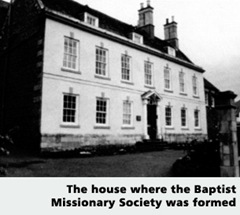
Andrew Fuller organized a meeting for October 2, 1792 at the home of a Mrs. Beeby Wallis. It should not be overlooked that Fuller was a man of great devotion to his Lord. He led this meeting only little over a month since his wife died.

Fourteen men met in the parlor. They were young (ranging in age from 26–40), unknown, and with very little financial resources. Their churches were small, located in small hamlets.

house-baptist-missionary-society-formed Fuller was appointed as secretary. A treasurer was appointed and three others, including Carey, comprised the leadership of the newly formed Particular Baptist Society for the Propagation of the Gospel Amongst the Heathen. An offering was collected and placed in a snuff box. They collected that week’s proceeds from the sale of the Enquiry equaling a small sum of 13 pounds, 2 shillings, and 6 pence (from proceeds collected that week from The Enquiry).

His appointment as a missionary

One month later, rumors were circulated that Carey was being considered as their first missionary to Sierra Leone, Africa. Mission work seemed out of the question for Carey. His church in Leicester was beyond the troubles of the past and growing steadily. His wife had never traveled beyond the county in which she was born. His wife was expecting another child. Nevertheless, these were rumors.

The Society secured the name of Dr. John Thomas. He had been to India twice, once as a surgeon and once as a missionary. Dr. Thomas was known to be a man of great character although he had accumulated a considerable debt. The Society overlooked this issue and appointed him as a missionary. They also asked Carey if he would serve as Thomas’ associate. Carey enthusiastically agreed without hesitation.

What about Mrs. Carey? What would she say? She didn’t like it at all. Matter of fact, she refused to go. Did it have much to do with the fact that she was due only a month before Carey would board the ship to India? Was it that she had never been away from home and considered Carey to be going insane? Maybe. It is difficult to say what would cause Mrs. Carey to have such strong resolve not to attend her husband in India. Nevertheless, she firmly refused to go. Only after William persistently pled with her would she let her oldest son go with him. Dr. Thomas, Carey, his son Felix and a few others boarded the ship April 4.

France declared war on Great Britain making the waters too dangerous to traverse. For six weeks, the ship had to dock on the Isle of Wight. Carey received a letter from Dorothy stating that all is well after the birth of their son.

Dr. Thomas’ indebtedness caught up with him. His creditors found he was on the ship. Events were such that Dr. Thomas, Carey, and his son were forced off the ship. The others were allowed to continue to India.

Having to secure another way, they went back to London. While there, Carey tried again to convince his wife to go. He failed. However, Dr. Thomas influenced Dorothy to go. Once she was boarded, she changed her mind, but it was too late.

Within a few weeks of their arrival in India, Dr. Thomas “squandered their entire annual allowance in a few weeks. Dorothy could not cope with their poverty, the death of another child, and living in a foreign land. She became insane and was locked up in an institution for the “last thirteen years of her life.

His ministry in India

carey-baptist-church For years, Carey did not see any come to know Christ. It was a difficult field, more difficult than Carey had imagined. The Indians feared conversion for it meant total outcast from everything they knew. It took Carey a few years to develop an understanding of their culture and fears so he could reach these Indians for Christ.

India is a land of a “thousand languages.” There were no Bibles in their language. Carey’s language learning abilities allowed him to produce many translations in their own language.

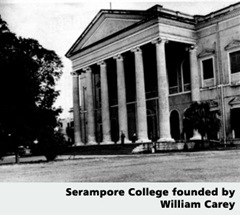
Later, Carey moved to Serampore and founded the Serampore Mission which engaged in producing translations of the Bible.

Conclusion

serampore-college One may wonder, “How did mission work in India help turnaround the Hyper-Calvinism in London?” As Fuller and others traveled throughout London, they preached on missions. Missions magazines were distributed throughout the country (including America) publishing the news of the Carey’s mission work in India.

The work of missions so convicted the Londoners that three societies were established to reach the “untouched” areas of Britain. Within five years, the membership of some congregations tripled and churches were established.

This carried into the next century in England. The Sunday School was founded, more publications were developed, new schools were established, and the work of foreign missions enlarged.

1 George, Faithful Witness, p. 49.

2 McBeth, p. 181.

3 Ibid.

4 Vedder, p. 249.

5 Ibid.

.Fuller 2:343–66. Cited by George, Faithful Witness, pp. 56–7.

Torbet, History, p. 80.

6 In those days, girls usually married at the age of 12, boys when they were 14.

From Eustace Carey’s work Memoir of William Carey, p. 37. Quoted by Timothy George, Faithful Witness, p. 20.

George, Faithful Witness, p. 27.

.Carey to his father, Leicester, November 12, 1790. Cited from George, Faithful Witness, pp. 26f.

by George Smith in his The Life of William Carey (1887). Cited in Faithful Witness, p. 31.

.John Sutcliff, a friend of Carey, actually encouraged the churches involved in the Northamptonshire Association to make it their practice to devote the first Monday of every month to prayer.

This phrase is often restated as Expect great things from God. Attempt great things for God. Though Carey would not disagree, these were embellishes. These additions have been attributed to John Ryland in an account he wrote 25 years later. See George, Faithful Witness, p. 32.

McBeth, p. 186.

Ibid.

.Ivimey, A History of the English Baptists, IV, 68–75. Cited by Torbet, History, p. 83.

.Torbet, p. 83.

Hello Freedom, Goodbye Purpose

Hello Freedom, Goodbye Purpose

During the last half of the 1600s, the Baptists in England flourished. While they were being persecuted for their faith, they planted nearly 130 churches within twenty years. These were days of great persecution, but also great growth and promise for Baptists.

When William and Mary ascended the throne, they brought with them a new toleration. They enacted the Act of Toleration in 1689, which provided Baptists, and other dissenter groups, with relative freedom. Though the Baptists could not attend the universities and still had to pay taxes to the Church of England, they were free to worship without fear of governmental penalty. Because of this new found freedom, a large number of Baptist churches in London gathered and openly adopted the Second London Baptist confession (written 12 years previously).

It would seem that the Baptists were poised for a great future. They had clearly laid out their beliefs, they now enjoyed religious freedom, and their number had grown remarkably. Unfortunately, given all of these great things, the English Baptists1 lost focus and spiraled into a century of great decline. What was the cause of this decline? They lost focus on their mission. This lesson will answer the following questions:

What is the mission of the church?

  • Why did the eighteenth century English Baptists neglect the mission of the church?

  • What did the eighteenth century Baptists do to recommit themselves to the mission of the church?

What is the Church to be Doing?2

The mission of the church is to reproduce itself

The corporate mission of the church is to reproduce congregations

Whereas personal witness seeks to produce converts, corporate mission seeks to produce congregations by organizing such converts into local churches. The bulk of the New Testament (from Acts to Jude) deals primarily with the starting and strengthening of local churches.

Paul’s first two missionary journeys resulted in the reproduction of churches. (Ac 13–14)

During Paul’s first missionary journey (Acts 13–14), he and Barnabas followed a clear plan: after being commissioned by their home church in Antioch of Syria, they established a new church in Antioch of Pisidia, from which they evangelized neighboring cities, establishing other churches.

syria-psidia

Paul’s second missionary journey: Paul followed the same pattern during his next missionary journey (Ac 15.36–18.22). On this occasion, Paul established the “mother church” in Ephesus, which commissioned Epaphras (Col 1.7) to establish churches in these other cities.

syria-ephesus

In both of these cases, Paul or a fellow worker communicated the gospel, organized congregations, taught them doctrine, helped them appoint pastors, and checked back on their progress. The end result was always an independent local church.

The corporate mission of the church is to reproduce in kind

Churches should reproduce doctrinally

Even a casual reading of Paul’s epistles reveals that he was determined to see sound doctrine established in the churches he started. To Timothy, Paul’s representative in the Church at Ephesus, he declared:

What you heard from me, keep as the pattern of sound teaching, with faith and love in Christ Jesus. Guard the good deposit that was entrusted to you. (2Ti 1.13–14)

Churches should reproduce philosophically

Paul was not only concerned about reproducing a doctrinal system in the churches that he established, but also about making sure those churches followed his application of doctrine.

Although I hope to come to you soon, I am writing you these instructions so that, if I am delayed, you will know how people ought to conduct themselves in God’s household, which is the church of the living God, the pillar and foundation of the truth. (1Ti 3.14–15)

The mission of the church is to reproduce itself abroad

The corporate mission of the church should be marked by extension. Christ’s last recorded message before His Ascension was:

But you will receive power when the Holy Spirit comes on you; and you will be my witnesses in Jerusalem, and in all Judea and Samaria, and to the ends of the earth. (Ac 1.8)

This can be visualized:

jerusalem-ends-of-earth

Corporate mission takes place within each church’s community

When most people hear the word “missions,” they usually think of ministry that takes place on foreign soil. The corporate mission of the church, however, includes the reproduction of congregations in one’s own community, provided the community is large enough to sustain multiple congregations.

Reproduction of congregations tends to promote service. The early church multiplied via many small house-churches due to the lack of facilities large enough to house all of the believers in a particular community. Although larger facilities are available today, it may be wise to limit the size of a church in order to promote service. As a church grows, it may reach the point where it starts producing spectators rather than servants. At that point, a new congregation should be started to provide more opportunities for service among its members.

Corporate mission takes place beyond each church’s community

The church that was established in Jerusalem was expected to minister beyond its own community. Its goal was to reproduce itself worldwide. Whenever Paul started a church and strengthened it to the point where it could function on its own, he left to start churches in other areas.

Our hope is that, as your faith continues to grow, our area of activity among you will greatly expand, so that we can preach the gospel in the regions beyond you. (2Co 10.15–16)

The mission of the church is to reproduce in spite of opposition

Logically, we tend to think that freedom of religion automatically brings expansion. We reason that if we remove the obstacles, growth will automatically occur. That is not the case. Though freedom of religion does eliminate certain hindrances, it does not guarantee that the mission of the church will be carried out. The mission of the church is only accomplished when it is intentionally pursued.

The early church believers and apostles lived in a day when Christianity was viewed as a threat to government. That is because unsaved man does not want to submit himself to the Lordship of Christ. The early believers suffered persecution, even death for their faith.

The following verses were written to encourage believers that hostility does not curtail God’s purposes, rather hostility is the “seed” of perseverance and expansion of the gospel.

But rejoice that you participate in the sufferings of Christ, so that you may be overjoyed when his glory is revealed. If you are insulted because of the name of Christ, you are blessed, for the Spirit of glory and of God rests on you. (1Pe 4.13–14)

Consider it pure joy, my brothers, whenever you face trials of many kinds, because you know that the testing of your faith develops perseverance. Perseverance must finish its work so that you may be mature and complete, not lacking anything. (Jas 1.2–4)

Now I want you to know, brethren, that my circumstances have turned out for the greater progress of the gospel, so that my imprisonment in the cause of Christ has become well known throughout the whole praetorian guard and to everyone else, 14 and that most of the brethren, trusting in the Lord because of my imprisonment, have far more courage to speak the word of God without fear. (Php 1.12–14)

With the mission of the church in mind, we will now see why the spiritual stagnation settled in among the Baptists of the seventeenth century.

Why did the eighteenth century English Baptists neglect the mission of the church?

During the first half of the 1700s, the Baptists began to decline. The number of churches in 1715 dropped from 220 to 146 by 1750. The number of churches declined by one third. That does not include the number of members in the churches. Many lost half of their membership during this decline.3

Why did they lose so many during this time? This question cannot possibly be adequately answered in one lesson. Historians offer many reasons for the decline: 1) exhaustion from fighting for religious freedom;4 2) failure to maintain a ministerial leadership;5 3) most prominently, their failure to evangelize (i.e., a belief in hyper-calvinism).6 Nearly every historian offers the latter cause for the decline. This is where we will focus our attention.

A Belief in Hyper-calvinism Led to the Decline of the Eighteenth Century English Baptists.

What is Hyper-calvinism?

In the 1800s there was a clear understanding of Hyper-calvinism. Yet, that understanding has been blurred over the past century. Some (John R. Rice) identify a Hyper-calvinist as one who believes all five points of Calvinism.7 Another (Douglas MacLaughlin) has recently noted that Hyper-calvinism8 is an “overemphasis [on the sovereign will of God] which tends to fatalism and dead ritualism.”9

Neither of the above statements correctly identifies the heresy of Hyper-calvinism. A belief in all five points of Calvinism is not Hyper-calvinism. Many “five-pointers” were not Hyper-calvinists. Neither is the problem one of “overemphasis.”10 How can one overemphasize the absolute sovereignty of God?

Hyper-calvinism is not equal to Calvinism. It is not uncommon for one to equate hyper-calvinism with Calvinism. Many fail to distinguish between the two. Some use the word “Hyper-calvinism” as a polemic against Calvinism. It is easier to defeat an opponent by attaching the word “hyper” to his system of thought than to dismantle his system with Scriptural proof. Hyper-calvinism is neither a logical nor necessary extension of Calvinism. It is an aberrant theology that distorts real Calvinistic thought.

The word “hyper” means to “go beyond.” This is really an unfortunate word. For Hyper-calvinism is not merely a difference in degree, as C.H. Spurgeon noted it is a “false Calvinism.”11

Historically, Calvinism has been broken down into two basic groups – Moderate Calvinism and High-Calvinism.12 Moderate Calvinism accepts all the tenants of Calvinism except for two (i.e., limited atonement and double predestination). High Calvinism accepts the common five including double predestination.13 It can be charted as follows:

calvinism-high-moderate

Hyper-calvinism is different from Moderate and High-calvinism. It is a system that rationalistically deduces that one should not offer the gospel to unbelievers. Hence it is sometimes (and unfortunately) called Non-offer Calvinism.14 Hyper-calvinism is characterized by the following:

  • An overt opposition to evangelistic efforts.

  • The thinking that expanding ministry is not a grand priority.

  • Seeking to build a ministry on transfers rather than fresh converts.

Hyper-calvinism produces a stagnation and apathetic attitude toward evangelism. This generally results in a decline in numbers. But that is not always the case. Historically, there have been many Hyper-calvinists who drew large numbers to their churches.15 The main problem of hyper-calvinism is not a lack of numbers, but a disdain for evangelizing for fresh converts.

They did not give up Calvinism, or, in other words, renounce the Confession of 1689, but they overlaid it with an incrustation of something, which approached Antinomianism, and ate out the life of the churches, and f the gospel as preached by many ministers. Divine sovereignty was maintained and taught, not only in exaggerated proportions, but to the practical exclusion of moral responsibility; the obligation of sinners to “repent and believe the gospel,” was ignored, and even denied, and all gospel invitations and pleadings were restricted to those who were supposed to give evidence of a gracious state.16

How did Hyper-calvinism show itself in the seventeenth century? Primarily, the decline in membership and number of churches was the obvious result of Hyper-calvinism. Interestingly, while the numbers were dwindling overall, many Baptist church buildings were built. Many were large, ornate, edifices that could seat thousands.17 The point is they worked at consolidating themselves into monumental ministries rather than planting a network of smaller, vibrant ministries to reach the unconverted.18

The mission of the church is to reproduce itself. That is not to say that there is no room for a large church. God uses large churches for special purposes (e.g., establish seminaries, colleges, etc.) The problem is not so much size but purpose. Since the purpose of local churches is reproduction, consolidation should be minimal.

One writer looks back to earlier Baptists (Kiffin, Knollys, and Keach) and offers this encouragement:

These examples give some indication, at least from among the leaders of the movement, for the spread of their message and the desire to see churches multiplied. For them, the church was not simply a society of holy people gathered for fellowship with one another, but was an instrument to bring light and life to the darkest places. When they were able, they encouraged and engaged in mission efforts within their capabilities. Undoubtedly, the relative poverty of many of the churches and their ministers hindered expansion. But efforts were made, at times with positive results.19

What did the eighteenth century English Baptists do to recommit themselves to the mission of the church?

Fortunately, hyper-calvinism died off and is virtually non-existent today. How did the Baptists recover? The following areas are noted by historians:

They developed associations of Baptist Churches

Also in 1768, Abraham Booth published The Reign of Grace to refute hyper-calvinism.20 He, along with John Rippon (Goat Street Church21) and John MacGowan (Devonshire Square Church) saw the need to combine their efforts to establish churches. By 1796, one new church was planted every two years.22

In 1770, a man by the name of Charles Whitfield organized churches in Durham. In Yorkshire and Lancashire, John Fawcett assembled seventeen churches into an association in 1787.

The establishment of these associations helped recover the biblical mission to reproduce churches of like faith and practice.

They supported their pastors – educationally, financially

The Act of Toleration prohibited Baptist ministers from attending Cambridge and Oxford. Added to that, many could not afford further education.

Baptist pastors received less compensation than other Dissenters, and far less than those in the state church.23 It was not uncommon for them to work other occupations to support their families. To help the pastors, a “London Fund” was established. This would be used to assist needy ministers and educate young men for the ministry.24 This fund was strictly designed for those who subscribed in full with the Second London Baptist Confession. Neither did they allow the Arminian General Baptists to contribute to this fund. This did not come without opposition.25 The fund still operates today and has been used to help many pastors survive in their ministries.

This fund along with another supported Bristol College. From 1760–1820, Bristol academy graduates filled London Calvinistic Baptist pulpits. This influx of evangelistically, well educated men helped overturn the ravages of Hyper-calvinism.

. . . . by the turn of the century [Hyper-Calvinism26] was, to all intents and purposes, a dead issue among Baptist Board-related churches.27

Missions movement and revivals

This is probably the most important factor that turned the Baptists away from hyper-calvinism. Men like Andrew Fuller and William Carey spearheaded a missions movement that virtually eliminated hyper-calvinism. Space is limited to expand this factor. The next lesson will focus entirely on the missions movement and its impact on Baptist Life.

1 Throughout this lesson, it should be noted that we are still looking only at the English Baptists. The American Baptists have a different history in the eighteenth century. That will be developed in lessons 8ff.

2 This point was extracted from Lesson 29 of the Biblical Foundations for Living series.

3 McBeth, pp. 172–3.

4 McBeth, p. 122; Torbet has a modified view in that he sees that they were “still preoccupied with the winning of religious liberty.” p. 69.

5 Torbet,

6 Vedder, pp. 239ff; Torbet, pp. 68ff; McBeth, pp. 171ff.

7 John Rice, Some Serious, Popular False Doctrines (Murfreesboro, TN: Sword of the Lord Publishers, 1970), p. 274.

8 He uses the terms “excessive Calvinism.” See various names used for “hyper-calvinism” Footnote on p. .

9 Douglas McLachlan, Reclaiming Authentic Fundamentalism (Independence, MO: American Association of Christian Schools, 1993), p. 63.

10 It is said that hyper-calvinism is an exaggeration of Calvinism. This is more accurate.

11 Iain Murray, Spurgeon v. Hyper-calvinism, p. 40.

12 Before the term “hyper-calvinist” was coined, they were called “High calvinists.” Since the 1900s the term “high calvinist” has been defined as it is in this lesson.

13 See ibid. pp. 737ff;

14 Hyper-calvinism has also been called Excessive Calvinism, Ultra-Calvinism, Extreme Calvinism, Pseudo-Calvinism, Hard Calvinism, Thorough-going Calvinism, Rigid Calvinism, Unbalanced Calvinism, and Calvinism-run-mad.” See Daniels, Hyper-Calvinism, pp. 747ff.

15 e.g., William Huntington, William Gadsby, James Wells. See Curt Daniels, Hyper-calvinism and John Gill, p. 448.

16 Sword and Trowel, 1889, p. 600. quoted by Ian Murray, Hyper-calvinism and Spurgeon

17 McBeth, p. 191;

18 Torbet, p. 68.

19 Jim Renihan, Church Planting and the London Baptist Confessions of Faith.

20 McBeth, p. 179.

21 Later became Spurgeon’s Tabernacle.

22 Torbet, p. 78.

23 McBeth, p. 191.

24 Torbet, p. 70.

25 McBeth, p. 187.

26 The original read “high calvinism.” Until the term “hyper-calvinism” was coined, “high calvinism” was used.

27 Continuity and Change, pp. 130–1 quoted by Iain Murray, Hyper-calvinism, p. 133.

Defining, Declaring and Defending the Faith

Baptists are committed to Scripture as their final authority of faith and practice. Perhaps nothing has solidified and proclaimed this commitment more than their writings. As we have seen in the last lesson, God has used and continues to use the writings of men to define and defend the faith. They took great pains (and received them as well) in declaring the faith to their friends, neighbors, and enemies.

Some say “Baptists do not use creeds.”1 While it is true that Baptists do not view creeds and confessions2 as Scripture, they certainly have value. Fact is, once you proclaim a truth that is consistent with Scripture, you have articulated a trustworthy creed. Their value lies only in their precise, clear proclamation of Scripture. A proper creed does not add to Scripture, it merely explains and proclaims God’s truth.

Literally hundreds of Baptist writings can be found in the seventeenth century, however for purposes of this lesson, we will focus on the most influential of them all – The London Baptist Confessions of Faith.

Do Confessions Conflict with Scripture?

Roman Catholics, Charismatics, and others have elevated their teachings to the same level as Scripture. There is a danger in relying on the teachings of men rather than Scripture. Yet, the apostles and early church believers rightly uses confessions (either written or verbal) for the purpose of teaching Scripture.

Certain “faithful sayings” were inscripturated.

The apostles did not criticize or rebuke people for saying and writing things that were true about Scripture. Instead, they encouraged the use of confessions.

The apostles called them “sound words” and most usually “trustworthy sayings.” Paul incorporated certain “faithful sayings” into his writings.3

Here is a trustworthy saying that deserves full acceptance: Christ Jesus came into the world to save sinners. . . . (1Ti 1.15)

Here is a trustworthy saying: If anyone sets his heart on being an overseer, he desires a noble task. (1Ti 3.1)

This is a trustworthy saying that deserves full acceptance (and for this we labor and strive), that we have put our hope in the living God, who is the Savior of all men, and especially of those who believe. (1Ti 4.9–10)

Early believers used writings and things taught to increase their understanding of Scripture.

We have a tendency to think that everything an apostle spoke and wrote was God’s Word. That is certainly not the case. On two occasions, Paul refers to his own writings that are not a part of our Bible. He used those writings to warn, encourage, and teach the early believers.4

Preaching is one mode (the primary mode) for communicating the truths of God’s Word. It is a verbal confession. Notice that the Bereans did not reject the preaching and teaching they received, rather, they studied the Scriptures to see if the teachings were accurately conveying God’s Word.

Now the Bereans were of more noble character than the Thessalonians, for they received the message with great eagerness and examined the Scriptures every day to see if what Paul said was true. (Ac 17.11)

The use of confessions helps believers practice what Scripture teaches.

Some confessions were written either because a heresy was introduced and needed to be denounced. Others were written to provide a common statement of faith whereby fellowship could take place. The earlier confessions made clear statements about the Triunity. This doctrine was one of the first controversies among early believers. Some of the earliest confessions were written to clearly enunciate the truth of the Triunity. Church historian, Robert Torbet, makes the following observations regarding the use of confessions:

  • Maintain purity of doctrine
  • Clarify and validate the Baptist position
  • To serve as a guide to the General Assembly or local association in counseling churches
  • To serve as a basis for fellowship within associations
  • To discipline churches and members by withdrawing fellowship.5

Summary: Do good confessions conflict with Scripture? No. Quite the opposite. They are tools which God has providentially used to define, declare, and defend His truths as found in Scripture. Our job is to make sure that what we write is consistently clearly in tune with Scripture.

Confessions used by Baptists

Baptists were among the first to produce modern confessions. “Modern” in the sense that the confessions were written in the last few centuries and in the sense that they are still used. This lesson will focus primarily on the mother6 of them all – The London Baptist Confessions.

The First London Baptist Confession

The history behind the First London Baptist Confession

During the reign of Charles I, Baptists endured physical mistreatment and slanderous accusations. These oppressions were doled out by the secular government as well as other religious bodies.

Many tried to link the Baptists with the Anabaptists. They said “Baptists are rebellious people who disobey authority.” This was a notorious accusation for earlier, Thomas Müntzer (May 15, 1525), considered an Anabaptist by most, led a mass of frustrated, confused, and discouraged peasants into a war that ended with their slaughter. Though history is replete with the testimonies of many godly Anabaptists, this famous massacre left a bitter scar on the minds of the monarchy and the people of Europe.7

Another difficulty for the Baptists during the 1600s was that another group of Baptists (i.e., General Baptists) bore the same name. That group had many differences as we have seen on pages 19ff. This was cause for concern for the Particular Baptists for their identity was confused. They wrote to show they were orthodox and not “out of that common road-way” of Scriptural truth.

The content of the First London Baptist Confession

The First London Baptist Confession was neither the first confession, nor the first confession in London. It was the first confession that the Particular Baptists drafted.

The framers (among whom were Kiffin and Knollys) of the London Baptist Confession relied on an earlier confession by separatist Henry Ainsworth – A True Confession of 1596.

Seven churches in London gathered to publish this confession to clearly identify themselves and their beliefs. In their words, people were falsely charging them with

. . . holding Free-will, Falling away from grace, denying Originall sinne, disclaiming of Magistracy, denying to assist them either in persons or purse in any of their lawfull commands, doing acts unseemly in the dispensing the Ordinance of Baptism, not to be named amongst Christians8: All of which Charges wee disclaime as notoriously untrue . . . 9

This confession includes the following doctrines:

  • Doctrine of God (articles 1–6)
  • Doctrine of Scripture (7–8)
  • Doctrine of Christ (9–20)
  • Doctrine of Salvation (21–30)
  • Doctrine of Spiritual Warfare (31–32)
  • Doctrine of the Church and Ordinances (33–47)
  • Doctrine of Christian Submission to Government (48–52)

Note what one person has to say about this confession

“This significant document of 1644 embodies practically every doctrine that present-day Baptists hold dear, and is, therefore vastly important in Baptist history.10

The Second London Baptist Confession

The history behind the Second London Baptist Confession

The First London Baptist Confession did not enjoy a wide distribution. Given the times during which the confession was drawn, few copies were made. Thirty-three years later, a more complete document was necessary. Since the production of the First confession, the Presbyterians produced a more elaborate confession – the famed Westminster Confession of Faith. The Congregationalists adopted the same confession for themselves making some adjustments in their document called the Savoy Declaration.

In a time when religious liberty was threatened, the Baptists also aligned themselves with the Presbyterians and Congregationalists by reworking their First London Confession. They used the Westminster Confession as their base and produced the Second London Confession in 1677.

The content of the Second London Baptist Confession

Though the Baptists aligned themselves with the Presbyterians and Congregationalists, they did differ. Baptists refused to use the word “sacrament” and chose to use the word “ordinance” instead. Matters regarding baptism and the Lord’s supper were not followed.

This second confession did improve upon the first in many ways:

  • Based on the more complete Westminster Confession
  • Chapter 1 challenged the Quakers and Seekers by 1) demonstrating a high view of Scripture; 2) promoting a proper view of the Holy Spirit’s work in our lives.

1.1 The Holy Scripture is the only sufficient, certain, and infallible11 rule of all saving Knowledge, Faith, and Obedience . . . 1.6 The whole Councel of God concerning all things necessary for his own Glory, Mans Salvation, Faith and Life, is either expressely set down or necessarily contained in the Holy Scripture; unto which nothing at any time is to be added, whether by new Revelation of the Spirit, or traditions of men.

  • Chapters 9–18 expand the great doctrines of salvation including definitive sections on election and perseverance.
  • Chapter 20 is a clear statement regarding the necessity to “preach the gospel in all ages and nations.”
  • Chapter 21 promotes religious freedom and liberty of conscience.
  • Chapter 22 section 5 was obviously influenced by Keach who promoted the singing “hymns and spiritual songs.” Many would only sing from the Psalms.
  • Chapter 26.11 made provision for lay preaching. That is, preaching was not “confined” only to the Bishops or Pastors.
  • Chapter 29 clarifies that Baptism does not remit sins but only “those who do actually profess repentance towards God, faith in, and obedience, to our Lord Jesus, are the only proper subjects of this ordinance.”

Notable areas where we would not follow the Second London Confession:

  • The confession demonstrates their current reliance on covenant theology. Throughout the confession one will find their use of the term “covenant” and “Sabbath.” As well, Chapter 19 speaks of the believer as being under the moral law and not the ceremonial law.
  • Chapter 30 includes many items regarding the Lord’s Supper with which we would disagree. 1) the duty of those ministers administrating communion to “bless the Elements;” 2) the Lord’s Supper is not restricted to scripturally baptized people. 3) the belief that Christ is “spiritually present” in the elements.

The Philadelphia Baptist Confession

The Baptists in America used the London confession across the “pond.” The first Baptist Association in America (Philadelphia Baptist Association [PBA]) adopted the Second London Baptist confession as their own. It only differed by the addition of the following sections:

  • Chapter 23: Of Singing Psalms, &c. This expansion came as a result of the diminishing singing controversy.
  • Chapter 31: Of Laying on of Hands. Strangely, the churches of the PBA considered this to be an ordinance alongside baptism and the Lord’s Supper. This practice developed into what we know now as the “hand of fellowship.”12

Conclusion

Baptists have a high view of Scripture. They have not remained silent regarding the gospel and all of the other precious truths found in God’s Word. In our day, many do not verbally express their faith for fear of ridicule. In the 1600s, when lives were ended, the Baptists daringly wrote, signed, and published the truths of Scripture.

Baptists are confessional people – at least they should be. Acquaint yourself with the confessions of the past and learn the precious doctrines of Scripture.13

1 John Christian, A History of the Baptists (Texarkana, TX: Bogard Press, 1922), 1:4.

2 Throughout this lesson we will use the terms “confession” and “creeds” synonymously.

3 For more on Paul’s use of quotations see George Knight’s book The Faithful Sayings in the Pastoral Epistles.

4 Paul wrote a letter to the Corinthians and Laodiceans, both of which we do not have today.

5 Torbet, p. 46.

6 The London Baptist Confessions were used by C.H. Spurgeon, the Philadelphia Baptist Association, and now the Reformed Baptists and certain independent fundamental Baptists.

7 Anabaptists (modern-day Mennonites) also disassociate themselves from this radical. For more information on this situation see The Mennonite Encyclopedia, s.v. Muentzer, Thomas, 3:785ff.

8 Some were charging the Baptists of baptizing people without clothes.

9 Preface of the London Confession of 1644. Original spelling maintained.

10 Harold Brown, “The History of the Baptists in England to 1644.” The Chronicle, January 1945, o. 14. Quoted in Wiliam Lumpkin’s Baptist Confessions of the Faith, p. 152.

11 This is the first time the word “infallible” appears in any Baptist confession.

12 Vedder, A Short History of the Baptists, p. 236.

13 Read William Lumpkin’s, Baptist Confessions of the Faith (Valley Forge, PA: Judson Press), p. 1969.

Kiffin, Knollys and Keach

Kiffin, Knollys, and Keach

What is a Baptist? Primarily, a Baptist is one who trusts the Bible as his only ultimate source of faith and practice. He seeks to apply Scripture to every facet of life. Along with other distinctives1, this simple belief spearheaded our Baptist forefathers into a web of controversy and persecution.

During their formative years the foremost difficulty Baptists faced was persecution from many fronts: the monarchy, Church of England, and certain protestants who desired to maintain their political clout. These institutions and groups tried to restrict others from three basic freedoms2:

  • Freedom of conscience: The Baptists wanted to freely express their beliefs from the pulpits and in books without fear of punishment.
  • Freedom of religion: The Baptists wanted to freely practice their beliefs by attending to formal worship without government restrictions.
  • Freedom from the state: The Baptists wanted the church to be a separate entity from the state. That is, they did not want the state to impose laws that restricted their freedom to worship.

Baptists were not the only ones to face these difficulties. Yet, they shouldered the load and eventually brought religious freedom to England and America. They “paved the way” for future generations of Baptists.

The Rocky Road of English Politics

1629–1649

Under the reign of Queen Elizabeth, the Baptists enjoyed a period of liberty previously unknown in England. This taste of freedom, even though it was limited, gave them a desire for more.

King Charles I changed all of that. He was a dictatorial king who wanted sole power. He unilaterally took control of the Church and secular governing bodies. He called himself the “Supreme Governour of the Church” and established William Laud to oversee the Church of England. He dissolved the Parliament in 1629, which commenced a civil war. Note McBeth’s observation of these times in relation to the Baptists:

In this oppressive environment Baptists emerged as a separate denomination. They made their early witness despite dangers, persecution, and great personal risks. Numbers of early Baptist suffered loss of goods, whippings, and imprisonments for their faith. Some were physically maimed; cutting off the ears and slitting the nose were favorite ways to impress upon Baptists the disfavor authorities felt for their views. . . . Many had their death hastened by being crowded into filthy and disease-ridden prisons.3

King Charles’ “reforms” did not come without opposition. One Member of Parliament, Oliver Cromwell, had achieved leadership status by this time. He formed an army that assassinated King Charles 1, beheading him in the dead of winter at Oxford University.

1649–1660

Oliver Cromwell’s army restored liberty for the Puritans, Baptists, and many other groups. Baptists made up a large contingency in his army. Some of whom were high ranking officials and members of Parliament.

These were glorious years for Baptists. Their number grew considerably.

1660–1665

Upon Cromwell’s death, no one was suited to carry his agenda forward. Charles II who fled to “the wilderness” after his father’s execution, returned and took the throne. In five years, he completely abolished religious liberty by the means of several new laws.

  • Law 1 (The Corporation Act): No one could serve in public office without having taken communion in the Church of England and conforming to the church.
  • Law 2 (Act of Uniformity): Required officers of all corporations to be ordained by the Church of England. They were to sign a statement agreeing to the doctrine and practice of the Church of England. 2000 ministers were forced to resign.
  • Law 3 (Conventicle Act): No more than five people (non-family members) could meet for worship in one’s home.
  • Law 4 (Five Mile Act): Prohibited all ministers of dissenting groups not to come within 5 miles of their former churches. That is they were not allowed to preach, teach, or even live within five miles.

These acts did much to restrict religious liberty. Even so, Baptists still met and worshiped.

1688

When William and Mary of Orange ascended to the throne in 1688, they found that the above laws were politically unpopular and practically impossible to continue enforcing.

  • Dissenters (including Baptists) still had to pay taxes to support the state church.
  • Dissenters could not serve in government or military posts.
  • Dissenters could not attend Oxford or Cambridge University.

The Early Baptist Pavers

It was during this time of history that the Puritans, and others fled to America to seek freedom – Religious and Political. However, three men (among many others) stayed in England – William Kiffin, Hanserd Knollys, and Benjamin Keach.4 Unfortunately one may only find their names in Baptist history tomes. Only Keach has received broader attention, and that because he is known primarily as a hymnwriter. These men deserve much attention for they were men who formulated the most defining confessions of Baptist belief. Each also contributed greatly to Baptist thought in various other writings. One defended the faith against the onslaught of mysticism. Another challenged the error of open church membership.5 They all contributed so greatly to the Baptist faith that their names ought to be commonplace among Baptists.

William Kiffin (1616–1701)

Young Kiffin was orphaned at the age of nine. His parents died as a result of the bubonic plague. Although Kiffin himself was infected by the plague, he was able to overcome the nine plague boils on his body.6

He apprenticed himself to a glover (brewer). Feeling dissatisfied with that occupation, he sunk into a deep depression. It was not long before he ran away from his master.

In God’s providence, Kiffin heard Thomas Foxley, a puritan preacher, speak on “the duty of servants to masters.” He returned to his master in deep conviction. Foxley’s message so impacted him that he would attend puritan preaching as often as he could. This soon led to his conversion.

As a young, single man, Kiffin showed an insatiable desire for God’s Word. He found other men who shared his passion. Note his testimony regarding their practice on Sunday mornings:

[We would] meet together an hour before service, to spent it in prayer, and in communicating to each other what experience we had received from the Lord; or else to repeat some sermon which we had heard before. After a little time, we also read some portion of Scripture, and spake from it what it pleased God to enable us; wherein I found very great advantage, and by degrees did arrive at some small measure of knowledge. I found the study of the Scriptures very pleasant and delightful to me.7

He joined the separatist church of John Lathrop and became a preacher of God’s Word. He was imprisoned for preaching and eventually fled to Holland for reprieve.

While in Holland, he became a very wealthy man in the shipping industry. His wealth gave him the ability to establish a relationship with Charles II. On few occasions he would float Charles II “loans.” Kiffin’s influence and wealth protected many poorer Baptists and Dissenters.

Kiffin was a prominent disputer. An issue commonly disputed was that of infant baptism. He along with three others in October 17, 1642, disputed on this very issue against Daniel Featley, a minister of the Church of England. That debate was published in tracts, which influenced others to the Baptist views.8

Kiffin, along with other Baptist leaders called a national assembly in 1689. Over one hundred Baptist churches were represented at that assembly. At that assembly, they approved and adopted the Second London Baptist Confession.

Another important matter settled at this assembly was that of fellowshipping with other churches that practiced open membership. Eight years prior to this assembly, Kiffin published his Sober Discourse which soundly refuted John Bunyan’s position of open membership. At the assembly, fellowship with, and recognition of, open membership churches was discouraged.

During the last decade of Kiffin’s life, his three children died, including his wife. He remarried a woman who eventually stole money from him and made false accusations against him. She was excommunicated from his own church. Nevertheless, he never failed in his commitment to Christ. In one of his final writings, he wrote:

The world is full of confusions: the last times are upon us: the signs of the times are very visible: iniquity abounds, and the love of many in religion waxes cold. God is, by his providence, shaking the earth under our feet; there is no sure foundation of rest and peace, but only in Jesus Christ.9

Hanserd Knollys (1599–1691)

Unlike the formally uneducated Kiffin, Knollys received an education at Cambridge University and became a minister of the parish church at Humberstone in London.

He resigned his position in 1631 when Archbishop Laud forced ministers to use the “sign of the cross at baptism.” Neither could Knollys admit wicked people to communion which was common in the Church of England.

In 1635 he left England to find religious freedom in America. While in America, he ran into the Congregationalists. They did not provide religious freedom either. He went back to England in 1641.

Within three years he became a Baptist and became a spokesperson for Baptist thought. He was an influential pastor of a large London church, approaching 1,000 people in attendance.

He was involved in the printed word. During a preaching tour, he preached a sermon which he later published entitled Christ Exalted. He revised the First London Baptist Confession (1646). He took part of public disputations and promoted the Baptist cause in London.

Within twenty years, during the Oliver Cromwell era, 130 churches were planted.

For a couple of decades (1640s–50s), a small sect of Puritans called the “Seekers” began to introduce mysticism. They were called “seekers because they “represented themselves as being continually engaged, that of seeking for the true Church, ministry, Scriptures, and ordinances, all of which, they alleged, had been lost.10” One of their chief heresies was that they considered one’s faith to be null if it was not attended to miracles. They believed that they had the “full gospel” because they had the miraculous gifts. Many Seekers eventually became Quakers. The Quakers’ mysticism went so far as to downgrade the Bible as a “mere history.11

God used Knollys to battle this heresy. He reasoned that the miraculous gifts were given to the first century believers to bring the Gospel into the world. They were special gifts used to establish the church and spread the gospel throughout the first century of Christianity. Knollys used the following Scriptures for support:

How shall we escape if we ignore such a great salvation? This salvation, which was first announced by the Lord, was confirmed to us by those who heard him. God also testified to it by signs, wonders and various miracles, and gifts of the Holy Spirit distributed according to his will. (Heb 2.3–4)

Then Jesus told him, “Because you have seen me, you have believed; blessed are those who have not seen and yet have believed.” Jesus did many other miraculous signs in the presence of his disciples, which are not recorded in this book. But these are written that you may believe that Jesus is the Christ, the Son of God, and that by believing you may have life in his name. (Jn 20.29–31)

Knollys did preach and believe that believers are gifted today, just not with the miraculous ones. He believed just as the Puritan preacher Thomas Adams:

Even still God works miracles, though we take no notice of them. That our hearts should be converted, this is a miracle. That our faith should believe above reason, this is a miracle … If he does not fetch water out of a rock, yet he fetcheth repentance out of sin, and makes the stony heart gush out tears; this is a greater miracle.12

Benjamin Keach (1640–1704)

Keach also had a Church of England background. He was baptized as an infant. While in his youth, he studiously read the scriptures. He realized that infant baptism was wrong. When he turned 15, he joined the General Baptists. He began preaching at 18 years of age. The precise date is not known, but he later left the General Baptists and became a Particular Baptist.

Benjamin Keach did much to promote religious liberty during the reign of Charles II. He wrote numerous pamphlets and documents. One such book entitled The Child’s Instructor; or, A New and Easy Primmer sent him to prison. For two days (two hours at a time) he was pilloried (bound in stocks). Customarily the townspeople would pelt the pilloried offenders with eggs. Not so with Keach. They stood and attentively listened to Keach proclaim the Word of God. He was imprisoned numerous times for preaching about believer’s baptism.

Keach was also the first to promote singing in church. This was a point of conflict back then. Some believed that singing in church was wrong. Why did the early Baptists find this to be so controversial? There were many factors. Isaac Marlow, the leading spokesperson against singing reasoned the following in his tract “The Controversie of Singing Brought to an End: A Tract on Singing.”

“There is no Example nor Command for such a Practice in the Worship of God under the Law.”

“Neither do our Brethren sing after the Example of the Primitive Christians in the first Gospel Churches” They believed that singing involved the exercise of a miraculous gift. Knollys caused confusion on this point because he believed the sung words and tunes were “dictated by the Holy Spirit.” Furthermore, he elevated singing to an ordinance.

“The singing practised in the primitive Gospel-Churches, differed from the common way of singing now in use.” Singing led to formalism since it was much like a written prayer. They also believed that singing in the early church was performed by only one voice and not that of the entire congregation.

“The Women’s vocal singing in the Church, a practice in common use, is chargeable with breaking to positive and express Laws of Christ, which are so plainly, clearly and fully worded.”

Others added that congregational singing compromised the purity of the church in that it was participated in by the unsaved as well as the saved.

The controversy of singing was so great that when Keach introduced singing it was only reserved for times after the observance of communion. It remained that way for six years. The church added singing to their services at times of public thanksgiving. It continued that way for another fourteen years. It was not until twenty years had passed that singing was practiced every Lord’s day. Those members who defied the practice of singing were excused to the chapel-yard while the rest of the congregation sang. Eventually they formed a church of their own.13

Conclusion

God used Kiffin, Knollys, and Keach to “pave the way” for future Baptists. Together, they defined and defended the faith through public disputation, printed materials, and the drawing up of the London Baptist Confessions. These men ministered together and fought for religious freedom. Some closing thoughts are:

  • God uses the written word to disseminate truth. In the days of Kiffin, Knollys, and Keach, books and pamphlets were distributed to spread the Good News.
  • God places scripturally prepared individuals in key positions to accomplish His purposes. There was great disparity in education between the orphaned Kiffin and Knollys, but God used both because they both devoted their minds to Scripture.

1 Other distinctives include: Priesthood of the believer, Two ordinances of Baptism and the Lord’s Supper, Regenerate, immersed membership, Soul liberty, Two offices of pastor and deacon, Separation of Church and State.

2 These freedoms are explained and further developed in Nettle’s By His Grace and for His Glory, pp. 26–28.

3 McBeth, p. 101.

4 One may wonder why John Bunyan is not included in this history of Baptists. John Bunyan surely had an impact on Baptist life and his book the Pilgrim’s Progress is still a favorite read. However, Bunyan would not have considered himself a Baptist. He was a separatist.

5 Open membership is the practice of accepting non baptized people into local churches.

6 Armitage, p. 467.

7 From B R. White, William “Kiffin, Baptst History and Heritage,” 2, No. 2 (July 1967), 94. quoted by Michael Haykin in Kiffin, Knollys, and Keach, p. 43.

8 H. Leon McBeth notes: “Between 1641 and 1700 at least 109 such public debates involving Baptists were held in England, with 79 of these between 1641 and 1660. These debates pitted one or more Baptist champions against opponents from Anglican, Quaker, Independent, or sometimes, Roman Catholic groups. Baptists welcomed these occasions, for they gave opportunity for declaring the gospel to large crowds, helped defend Baptists against unjust slanders, and often led to numerous conversions and the planting of new Baptist churches.” p. 64.

9 From a quote by Joseph Ivimey, The Life of Mr. William Kiffin, quoted in Haykin’s Kiffin, Knollys, and Keach, p. 52.

10 McClintock, and Strong, Cyclopedia of Biblical, Theological, and Ecclesiastical Literature, 9:506.

11 McBeth, Sourcebook, p. 69.

12 Quoted in Haykin, Kiffin, p. 57.

13 Maze Pond Church February 1693.

The Emergence of the Baptists in England

The Emergence of the Baptists in England

There were some things, perhaps many that provided fertile soil for the beginnings of what we call the Baptist denomination. It was a complex beginning. Political and religious factors forced men to question the nature and function of churches. Some sought to reform the Church of Roman and England. While others knew that was impossible, so they separated from those two institutions and began new denominations. Among those new denominations, we find the Baptists.

The Political Background

In 1534, King Henry VIII broke away from the Roman Catholic Church. He established the Church of England, also known as the Anglican Church. Yet, it retained a Catholic flavor.

Interestingly, Henry VIII did not seek the tutelage of Anglicans for his son Edward VI, rather he chose the Protestants. When Edward assumed the throne he pushed the break from Rome even further. He styled the Church of England in a protestant fashion. His toleration of the reformers sparked reform movements throughout Europe. That lasted for only six years, the length of Edwards reign, which was cut short by death.

His stepsister, Mary Tudor changed all of that. She instantly reversed Edwards’s protestantizing of the Church of England and made it Catholic once again. She did this by force, lethal force. So lethal was Mary, her nickname was “Bloody Mary.” She was “bloody” in that she ordered mass executions of Protestants.

Mary’s reign was brief also, lasting only six years. However, in those years, she brought the Catholic-style back into the Church of England. Her sister, Elizabeth assumed the throne in 1559. Right away, knowing that the English began to enjoy the Protestantizing of the Church of England, Queen Elizabeth attempted to strike a compromise between the Catholics and the Protestants. She established a religious system known as the “Elizabethan Settlement.”

As with compromise, the only ones truly satisfied are the moderates. Those who truly wanted to follow Scripture and worship God in a pure fashion were not satisfied with this “Settlement.”

The Religious Background

Although the political structure of England was tumultuous, Christianity was experiencing a glorious reformation. Martin Luther led the Germans to true Christianity by nailing his 95 theses on the doors of a Catholic church decrying indulgences and other various heresies. John Calvin led the French and Swiss the doctrines of grace. Zwingli proclaimed the scriptures verse by verse, allowing them to speak for themselves without having the “Church” interpret the holy writ for the masses. These men opened the doors for a true reformation and revival.

These reformers proclaimed Sola Scriptura, Sola Fide, Solus Christus, and Sola Gratia. These Latin phrases are Scripture alone, Faith alone, Christ alone, and Grace alone, respectively. This sent a missile into the Vatican in Rome. Some of these men (and many of their followers) lost their lives defending these truths.

As the Church of England settled on its compromise between Catholicism and Protestantism, a number of persevering saints opposed it.

The Puritans

Not convinced that the Church of England has seen its last days, these believers wanted to reform the Church. They did not want to leave it, but to bring it back to a “purer” theology. Hence they were named “Puritans.”

The Separatists

Some were not so convinced. They were more pessimistic (which is not always a bad word) that the Church was beyond repair, so they separated from it, hence the name “Separatists.” It is from this latter group of believers that the first Baptist church in history makes its debut.

The Baptist background

The General Baptists

John Smyth (c 1565–1612), was born and raised in the Church of England. He studied at Cambridge University and became a minister in the Church. It was not long before Smyth was “won to the principles of the Puritan Brownists.”1 This was his first step Both he, and a man by the name of Thomas Helwys, soon rejected the Puritan’s beliefs regarding infant baptism. The Mennonites were influential in persuading Smyth and Helwys regarding believer’s baptism. Having this infantile, yet developing, understanding, Smyth baptized himself,2 as well as Thomas Helwys and the rest of his congregation. This moment is that which most historians consider to be the first Baptist congregation.

Smyth did not stay a Baptist for long. He followed the Mennonites too closely. It was not long before he desired to become a Mennonite.3 Helwys and a few others split from Smyth. Unfortunately Smyth gained a greater following and requested membership with the Mennonites. They stayed his membership request for three years.4 During that time, Smyth died. However, after his death, the Mennonites did admit Smyth’s congregation into their number. Helwys continued to pastor the Baptists.

The General Baptists, though first, are not the direct ancestors of our Baptist heritage. There were many differences between them and the Particular Baptists. These will be spelled out in more detail.

Particular Baptists

In another city, at another time, another variety of Baptists began. Though not a Baptist, Henry Jacob, an English Separatist, founded a church in 1616. Jacob and the two succeeding pastors (Lathrop and Jessey) developed an understanding of church life from the Scriptures. Some of the members were not so patient with the church in its development. One particular man, Samuel Eaton, left the church and started his own congregation. Meanwhile, Jessey did settle on believer’s baptism by immersion by 1638.

It is not clear that Eaton himself was a Baptist, but a member of his church, Richard Blunt, persuaded the church to baptize believers by immersion. They became a Baptist church by 1640.

Differences between the General and Particular Baptists

Not only were the General and Particular Baptists different in their origin, they were different in their beliefs and practices.

Differences of Theology

Particular Baptists were Calvinists, whereas the General Baptists were Arminian. The following table represents these differences.5


Particular Baptists
2nd London Baptist Confession

General Baptists
Orthodox Creed

Election God has elected certain individuals to salvation. Only they will come to Christ, and they come only by God’s free and unmerited choice. All who believe in Christ are elect. Election is not of individuals but of Christ himself. Anyone who comes into Christ becomes elect.
Atonement Jesus died for his elect only, and the benefits of his death are applied to the elect when God generates faith in their lives. Jesus died for all men, and any person may partake of the benefits of Christ’s death by accepting Christ when the gospel is preached.
Free Will Man lost free will in the Fall. He has lost any ability to will spiritual good. He cannot convert himself or even prepare himself for conversion, for he is dead in trespasses and sins. Man is wholly passive at the moment of regeneration. The will is made immutably free only in the state of glory. Although man does not have free will, God’s grace, which is the offer of salvation, frees man’s will so that he may either choose or reject that grace without bing compelled for or against the offer.
Perseverance The elect can never finally or totally fall away; they are kept by the power of God unto salvation. True believers may from lace of watchfulness fall from the grace of God and become withered branches cast into the fire and burned.
Sin Man is conceived a sinner, Man becomes a sinner upon his first act of sin.

The General Baptists held to a subjective, mystical, understanding of the Christian life. They were more like the Quakers.

When it came to issues of separation, the General Baptists compromised two cardinal doctrines. They associated themselves with a preacher by the name of Matthew Caffyn (1628–1714) who denied the Trinity and the deity of Christ. By the late 1700s, the General Baptists died off, many of whom became Unitarians.

Though General Baptists immersed professing believers, they wrongly believed that baptism was a symbol of the washing away of sins. Particular Baptists “recovered the view of baptism as a testimony to the death, burial, and resurrection of the Lord Jesus.”6

They differed in their structure

Both Particular and General Baptists enjoyed fellowship with other churches. Both groups formed associations. General Baptists established a hierarchal framework. That is, they made their churches subject to the association. They were not truly self-ruling churches.

Conclusion

God has ordained the events of this world to bring about His Sovereign purposes. As we have learned today, it pleased God to use a monarchy (even a wicked one), the Puritans, and Separatists to prepare the way for a new denomination – the Baptists. We find a number of biblical principles at work:

God is sovereign. No monarch or movement can thwart His purposes.

The king’s heart is in the hand of the LORD; he directs it like a watercourse wherever he pleases. (Pro 21.1)

His dominion is an eternal dominion; his kingdom endures from generation to generation. All the peoples of the earth are regarded as nothing.He does as he pleases with the powers of heaven and the peoples of the earth. No one can hold back his hand or say to him: “What have you done?” (Dan 4.34–35)

Man is responsible. He is to respond to God’s sovereignty in utter dependence and radical obedience.

Then the word of the LORD came to Jonah a second time: “Go to the great city of Nineveh and proclaim to it the message I give you.” Jonah obeyed the word of the LORD and went to Nineveh. Now Nineveh was a very important city – a visit required three days. (Jnh 3.1)

Peter and the other apostles replied: “We must obey God rather than men! (Ac 5.29)

As man searches the Scriptures and follows them as God’s very words, he will seek to win others to the same truths.

One night the Lord spoke to Paul in a vision: “Do not be afraid; keep on speaking, do not be silent. For I am with you, and no one is going to attack and harm you, because I have many people in this city.” So Paul stayed for a year and a half, teaching them the word of God. (Ac 18.9–11)

Since, then, we know what it is to fear the Lord, we try to persuade men. What we are is plain to God, and I hope it is also plain to your conscience.… If we are out of our mind, it is for the sake of God; if we are in our right mind, it is for you. For Christ’s love compels us, because we are convinced that one died for all, and therefore all died. And he died for all, that those who live should no longer live for themselves but for him who died for them and was raised again. (2co 5.11, 13–15)

While we may appreciate the history of Baptists, we must never lose sight that we are motivated by the above principles. Failure to cherish, obey, and proclaim these principles will again make fertile ground for persevering believers to destroy the foundation our forefathers laid in our heritage.

1 Brownists were those Puritans who followed Robert Browne. Robert Browne did not remain a Puritan however. He defected back to the Church of England. The Mennonite Encyclopedia, “Smyth, John,” p. 554.

2 The common mode of baptism was that of affusion (pouring water over one’s head). Though Smyth was right regarding the necessity of believer’s baptism, he did not practice baptism in the correct way by immersion.

3 The Mennonites believed in apostolic succession. That is, they were the true church because they could trace their beginnings back to John the Baptist. Smyth wrongly believed that this made his previous baptism null and void. Therefore, Smyth desired to join their number.

4 Helwys wrote the Mennonites warning them not to accept Smyth because of his theological drifts.

5 L. Russ Bush and Tom J. Nettles, Baptists and the Bible (Nashville, TN: Broadman & Holman Publishers, 1999), p. 31.

6 Michael Haykin, Rediscovering our English Baptist Heritage: Kiffin, Knollys, and Keach (Leeds, Ontario: Reformation Today Trust, 1996), p. 26

The Beginnings of the Baptists

The Beginnings of the Baptists

The primary and most essential distinctive of Baptists is their commitment to Scripture. They maintain that Scripture is the very word of God. As such, it is sufficient for all matters of faith and practice. It is God’s revealed truth.

Yet it also pleased God to reveal His works in time. He has used thousands of years, with billions of people to shape the world in which we live. This too is God’s revealed truth. As the Bible records historical events, we can be assured that they are true and give God’s authoritative instruction. As men recorded historical events, apart from supernatural inspiration, we can enjoy what we learn, but must be ever careful that we do not elevate those facts to the same authority of God’s spoken Word.

Therefore, history has the mark of man on it. Facts are obscured by opinion and lack of resources. This course on Baptist history suffers from the same tendencies. As we study the following events we need to be ever mindful that we seek the right resources with the right motives. In the end, we will profit from its study.

The Profit of History

Exactly how does one profit from history? Why is it necessary that every Baptist a study his heritage? Phillip Schaff, a church historian, identifies at least two benefits for the study of history.

First, he states, “The present is the fruit of the past, and the germ of the future.1” One can look back and see how biblical truth has impacted the way of life for the Baptists. Where they have properly identified and obeyed truth, we must do likewise. On the other hand, where mistakes have been made, time has a way of revealing them. May it never be said of us “What experience and history teach is this – that nations and governments have never learned anything from history, or acted upon any lessons they might have drawn from it.2” Or more simply stated, “The failure of many is that they fail to learn from history.”

The second benefit is that the Christian will find history to be “. . . a storehouse of warning and encouragement, of consolation and counsel.3” As the believer views history through the lenses of Scripture, he will see that God has been faithful to His people throughout all ages. Therefore, as a believer you should be motivated to obedience and encouraged by the many blessings others have received because of their obedience.

The Duty of the Historian

History is a scientific endeavor. It is based on facts, documents, and objects. Probably the highest duty of the historian is to acquaint himself with as many factual sources as possible and correlate those facts into a readable and living record.

When it comes to Baptist origins, we need to understand that these Christians are not immune from the effects of human depravity. Errors have crept into our Baptist History books – a few intentionally, many unwittingly. While the subject of Baptist origins is not a major issue, some clarification needs to be made.

There are Different Views of Baptist origins

Essentially, one could “boil” down the various views into two categories – the “Successionist” and “English Separatist” views.

Successionist views

Landmark theory. Also known as the JJJ (Jesus-Jordan-John) view, this theory states that we can trace the Baptists back to these three. Although the name “Baptist” did not appear throughout the centuries, they claim that Baptists did exist. As J.M. Carroll illustrated in his chart, Baptists were known by various nicknames – Montanists, Cathari, Donatists, Waldenses, Anabaptists, etc. (See illustration.) His chart illustrates the view that Baptists have existed in parallel succession to the Roman Catholic Church.

Spiritual kinship theory. Some are careful to distinguish themselves from the above strict Landmark view. They do recognize that it is impossible to prove that the Baptist denomination existed. However, they still strongly emphasize a succession of Baptist beliefs among these believers. They call this a “spiritual” connection. Often, they present this historical connection with a dogmatism that sometimes confuses them with the Landmarkists. They are especially intrigued by the Anabaptists and maintain that Baptists have direct successionist roots from them.

The problems with the successionist views. These views have gained popularity among Baptists since the early 1900s. Why have these views been adopted by many? The following statement is commonly used to support the above views.

“Since Christ promised that He would establish His church in every age, and Baptists are the true Church, they must be found in every age.”

Successionists buttress this claim by the following verses. They believe that Christ taught that Baptists (or those who are Baptistic) are the true church, and He promises that they will continue to survive.

And I say also unto thee, That thou art Peter, and upon this rock I will build my church; and the gates of hell shall not prevail against it. (Mt 16.18)

Go ye therefore, and teach all nations, baptizing them in the name of the Father, and of the Son, and of the Holy Ghost: Teaching them to observe all things whatsoever I have commanded you: and, lo, I am with you alway, even unto the end of the world. (Mt 28.19–20)

Unto him be glory in the church by Christ Jesus throughout all ages, world without end. Amen. (Eph 3.21)

Successionists claim that these verses speak only of “local churches.” They deny that a universal body of Christ exists. Therefore, they believe that a succession of local churches is essential because of Christ’s promises. This interpretation violates at least one principle of biblical interpretation. This principle is that interpretations must be consistent with the whole of Scripture. Those who deny that the universal church exists do so because they assume the Bible never teaches that.

Consider the word “church” in the following passage:

And God placed all things under his feet and appointed him to be head over everything for the church, which is his body, the fullness of him who fills everything in every way. (Eph 1.22–23)

The word “church” in this passage can only mean the sum total of all believers, the “universal church.” The “successionist” cannot legitimately interpret this as a “local congregation.” If this referred to a local church, the verse “which is his [Christ’s] body, the fullness of him who fills everything in every way” would pose serious theological difficulties.

Anyone familiar with local churches will readily admit that unsaved people are often a part of the membership. Furthermore, there are Christians who are not members of a local church.

A “universal” church does exist. Other passages teach the same (Heb 12.23; Col 1.18). Since the Scriptural evidence is clear that a “universal” church does exist, one should not try to force Matthew 16.18; 28.19–20; and Ephesians 3.21 to speak of a local church. To deny the “universal” church and press these passages to refer to the local church is to deny the whole teaching of Scripture and foist an alien meaning upon these passages.

Another principle of interpretation violated by the successionist is that a verse cannot mean what it never meant. The “John 3.16” of the successionist position is Christ’s promise in Matthew 16.18. It is usually the starting point for the successionist’s argument that Jesus Christ promised that the gates of hell should not prevail against the local church? When Jesus spoke of the church in this passage, did the apostles understand it as a local church? This passage is the first use of the word “church” in the NT. The word “church” means a “called out assembly.” Not until the book of Acts does the word “church” take on the more technical definition of “local assembly.” When Jesus Christ spoke of the “church” He was not intending to be unclear. The disciples knew what He meant. The church, all believers in their sum total would not have to fear a destruction by the gates of Hades. Jesus Christ did not tell the disciples that local Baptist churches would continue until eternity. If He did make this promise, why do we not see the Baptist name prior to the 1600s? Why do local Baptist Churches occasionally die off? When Christ made the promise in Matthew 16.18, He was not giving Baptists a promise for an succession of their denomination. What He meant, and the disciples understood, the gates of Hades will not prevail against the sum total of those who have placed their faith in Christ.

“Anabaptists, Waldenses, Paulicians, Donatists, and Tertullians all baptized by immersion those who professed faith in Christ. Furthermore, these groups rejected a hierarchical church government, therefore, they were Baptists.”

While it is true that some of these groups held to viewpoints shared by Baptists today, it is not conclusive (or desirable) to say that they were Baptists. Groups other than Baptists held to the same beliefs (e.g., Puritans and Congregationalists). Some of these groups were heretical in many of their beliefs.

The Anabaptists had many views that were non-Baptist. They practiced pacifism. That is a belief that Christians are not to participate in war. They also believed that it is wrong for Christians to make oaths. Do Anabaptists still exist? Yes. They are not Baptists. They are still called Anabaptists and Mennonites.

Furthermore, the first Baptists did much to disassociate themselves from the Anabaptists. The Second London Baptist Confession of the Faith in 1689 contained the subtitle, “Commonly but falsely called Anabaptists.” The next edition reworded the subtitle as “Commonly and unjustly called Anabaptists.” It is a curious thing that the defining document of Baptists is typically ignored in the successionist literature. Perhaps this little phrase would spoil (as it does) their contention that Baptists are Anabaptists.

“A succession to the days of John and Jesus is proof that Baptists are the true Church.”

Amid the multitudes stood Jesus. Behold the Lamb of God! exclaimed the enraptured herald of the kingdom. And then in those waters, consecrated by a thousand sacred associations, Jesus was baptized, while from the parting heavens came the approving voice of the Father, and the anointing symbol of the Holy Ghost. Thus it was, and there it was, that our denomination had its origin. Nor can learning nor ingenuity fix another spot, nor another period. Baptists! the flag that floats over you is that of Jesus only; the principles that govern you have the authority of Jesus only; the ordinances which distinguish you have the example of Jesus only; and the founder of your churches is Jesus only. S.H. Ford, The Origin of Baptists, pp. 104–5.[emphasis his]

[The] designation being “Ana-Baptist.” This compound word applied as a designation of some certain Christians was first found in history during the third century; and a suggestive fact soon after the origin of Infant Baptism, and a more suggestive fact even prior to the use of the name “Catholic.” Thus the name “Ana-Baptists” is the oldest denominational name in history. J.M. Carroll, The Trail of Blood, p. 51. [emphasis his]

Pure doctrine, as it is found uncorrupted in the word of God is the only unbroken, though often disturbed, line of succession which can be traced thru all the centuries . . . in fact if the Church perished and no longer existed it meant that Christ was unable to prevent that disaster and the Gates of Hades did prevail against the Church. We simply DO NOT believe this has occurred. Therefore we must reject the JOHN SMYTHE (1608) See-Baptism movement as the origin of the Baptists. A.A. Davis, The Baptist Story, pp. 8–9 [emphasis his]

It would be nice to say that Baptists have a direct succession from the time of Christ. However, a succession neither proves nor disproves that a church is biblical. Using a succession construct to prove that Baptists are the true Church smacks of the Roman Catholic tradition in proving Apostolic succession from the Apostle Peter. Some Landmarkists follow certain Mennonites in claiming baptismal succession. That is, one can genealogically trace his baptism back to John the Baptist. We would not say that a succession proves the Catholic theory, nor should we use a succession to prove a Baptist theory. History is based on factual documentation, not on presumption.

English Separatist View

Having outlined and interacted with the successionist views above, it should be clear to the reader that Baptist origins, in view of this writer, cannot be traced back to John the Baptist. From all known documentation, Baptists originated in England in the early 1600s. We have no other historical documentation of Baptist existence prior to this time.

Does this mean that Anabaptists (or other earlier groups) had no influence on the early Baptists? No. The influence was there, but it was quite minor compared to the influence of the English Separatists.

Who were the English Separatists? How did the Baptists rise out of this contingent of believers? These things will be developed in future lessons.

Conclusion

This is a minor issue and it should be understood that this writer does not view this as a cardinal issue. Yet, the underlying problem is worth the effort in correcting. Some believe that a historical progression is necessary to prove that the Baptist faith is the true faith. The marks of true faith are based on Scripture, not historical genealogy.

While minor, these successionist views are still being promoted in most Baptist Bible colleges today. You will usually find at least one faculty member on staff that holds to these views. With that in mind, consider the following quotes from three fundamental Baptist seminary professors:

“In the church history course that I teach from the Reformation to the 19th century, I present the origins of the Baptists as a branch of the English Separatists. Others at Calvary advocate the spiritual kinship theory.” (Clint Banz, Librarian and Church History professor at Calvary Baptist Theological Seminary)

“No one at Central affirms a Landmark view of Baptist history. In fact, we are quite committed to opposing this view . . . Genetically and historically, Baptists do come out of English separatism. We have great spiritual kinship with some Anabaptists (e.g., the Swiss brethren), but not with others (e.g., the Muensterites). The Waldenses are probably more like Presbyterians than they are like Baptists: We probably have people [that hold to a spiritual kinship view and an English Separatist view].” (Kevin Bauder, Ph.D. Systematic and Historical Theological Department Chair at Central Baptist Theological Seminary in Minneapolis, Minnesota)

“We at DBTS hold to the English Separatist view of Baptist origins, while recognizing a doctrinal kinship with groups who are not Baptist but, to some degree, embrace New Testament principles which Baptists affirm. The agreement would be limited to select doctrines, not with the groups holding them. For example, some sects in church history practiced adult baptism, but they were heretical in other respects. True Baptists accept the practice but not as a ‘successor’ to the heretical group. Following the strict successionist view requires either forcing earlier groups into a ‘Baptist’ mold, or relying on historical tradition for the validation of belief, rather than the New Testament.” (Dr. Gerald Priest, Professor of Historical Theology, Detroit Baptist Theological Seminary)

1 Philip Schaff, History of the Christian Church (Eerdmans, 1910) 1:20.

2 G.W.F. Hegel, Lectures on the Philosophy of World History, introduction.

3 Schaff, History, 1:21.

Baptist History

Baptist History

by Barry Pendley

Baptist History is a study on the foundations of Baptist groups, primarily the Calvinistic Baptists. This group of lessons will focus on rise of Baptist men from the English separatists in the sixteenth century. Consideration will be given to the Baptist Confessions, theologians, pastors, and other leaders. This study will also examine movements such as the Northern Baptist Convention, Conservative Baptist Association, and modern fundamentalist groups.

Lesson 1: The Beginnings of the Baptists

Lesson 2: The Emergence of Baptists in England

Lesson 3: Kiffin, Knollys, and Keach

Lesson 4: Defining, Defending and Declaring the Faith

Lesson 5: Hello Freedom, Goodbye Purpose

Lesson 6: Focusing on Mission

Lesson 7: Baptist Beginnings in America

Lesson 8: Growth, Separation and Struggle During the 1700s

Lesson 9: Organization and Growth in the 1800s

Lesson 10: The Northern Baptist Convention

Lesson 11: Influence of Separate?: Baptist Bible Union

Sources

Successionist Views

Armitage, Thomas. A History of the Baptists: Traced by their Vital Principles and Practices, From the Time of Our Lord and Saviour Jesus Christ to the Year 1886. New York: Bryan, Taylor, and Co., 1887.

Carroll, J. M. The Trail of Blood. Lexington, KY: Ashland Avenue Baptist Church, 1931.

Cummins, David and E. Wayne Thompson. This Day in Baptist History. Vol. 1. Greenville, SC: Bob Jones University Press, 1993.

————————. This Day in Baptist History. Vol. 2. Greenville, SC: Bob Jones University Press, 2000.

Davis, A. A. The Baptist Story: Sermons on the Trail of Blood. Shelbyville, TN: 1999.

Ford, S. H. The Origin of the Baptists. Texarkana: TX: Bogard Press, 1950.

Orchard, G. H. A Concise History of Baptists. Texarkana:TX: Bogard Press, 1956.

English Separtist Views

Haykin, Michael. Rediscovering our English Baptist Heritage: Kiffin, Knollys and Keach. Leeds, England: Reformation Today Trust, 1996.

McBeth, H. Leon. The Baptist Heritage. Nashville, TN: Broadman Press, 1987.

Torbet, Robert. A History of the Baptists. Valley Forge, PA: Judson Press, 1950.

Vedder, A Short History of the Baptists. Valley Forge, PA: Judson Press, 1907.

Other Writings

Beale, David. In Pursuit of Purity. Greenville, S.C.: Unusual Publications, 1986.

Clearwaters, Richard. The Great Conservative Baptist Compromise. Minneapolis, MN: Central Seminary Press, n.d.

Cummins, David. A Brief History of Baptist Missions. Jacksonville, FL: Victory Press, 1998.-

Estep, William. The Anabaptist Story. Grand Rapids, MI: William B. Eerdmans, 1975.

Gaustad, Edwin, ed. A Documentary History of Religion in America to the Civil War. Grand Rapids, MI: William B. Eerdmans, 1982.

————————. A Documentary History of Religion in America Since 1865. Grand Rapids, MI: William B. Eerdmans, 1993.

George, Timothy and David Dockery, eds. Baptist Theologians. Nashville, TN: Broadman & Holman Publishers, 1990.

George, Timothy and Denise, eds. Baptist Confessions, Covenants, and Catechisms. Nashville, TN: Broadman and Holman, 1996.

————————. Baptists and Their Doctrines. Nashvile, TN: Broadman and Holman, 1995.

————————. Baptist Why and Why Not. Nashville, TN: Broadman and Holman, 1996.

Good, Kenneth. Are Baptists Calvinists? Oberlin, OH: Regular Baptist Heritage Fellowship, 1975.

Lumpkin, William. Baptist Confessions of Faith. Valley Forge, PA: Judson Press, 1969.

Marsden, George. Fundamentalism and American Culture. Oxford, England: Oxford University Press, 1980.

McBeth, H. Leon. A Sourcebook for Baptist Heritage. Nashville. TN: Broadman Press, 1990.

Nettles, Thomas. By His Grace and for His Glory: A Historical, Theological, and Practical Study of the Doctrines of Grace in Baptist Life. Grand Rapids, MI: Baker Book House, 1986.

————————. Teaching Truth, Training Hearts: The Study of Catechisms in Baptist Life. Amityville, NY: Calvary Press Publishing, 1998.

Noll, Mark. A History of Christianity in the United States and Canada. Grand Rapids: William B. Eerdmans, 1992.

Shelley, Bruce. Conservative Baptists: A Story of Twentieth-Century Dissent. Denver, CO: Conservative Baptist Theological Seminary, 1960.